
The most common ICP advice is to copy your best customers, turn their traits into a filter, and then scale outreach to everyone who matches. That advice is backwards. If you treat an ICP in sales as a solved profile instead of a testable hypothesis, you'll optimize copy for accounts that were never going to buy, retain, or expand.
I would start narrower. Pick segments you can prove or disprove with pipeline economics, add the legal and platform checks before you build lists, and decide in advance when you'll kill, narrow, or expand each segment.
What an ICP Is and How It Differs From a Buyer Persona
An ideal customer profile (ICP) is a company-level definition of the account most likely to gain substantial value from your solution and generate strong commercial value in return. A buyer persona describes one individual decision maker inside that account. That distinction matters because the ICP decides which accounts enter a list at all, while the persona decides how you talk to a person once the account qualifies.
The ideal customer profile template guidance defines the account using measurable attributes such as industry, company size, geography, technology stack, business model, buying cycle, budget, and purchase triggers. The concept is also associated with Strategic Selling, where Miller Heiman developed it to stop salespeople spending disproportionate effort on accounts that should have been disqualified or handled differently.
A practical example
Say you sell a sales engagement tool. Your ICP might be 20 to 200 person B2B companies running Salesforce or HubSpot, with a dedicated SDR team and a recent hiring round. That's the account filter.
Your persona is different. It's the Head of Sales who wants consistent follow up while new hires ramp, or the RevOps lead who worries about CRM fields and duplicate outreach. Same deal, two documents, two jobs.
| Element | ICP | Buyer persona |
|---|---|---|
| Unit of analysis | A company account | One individual |
| Core attributes | Industry, headcount, geography, tech stack, budget, buying triggers | Job title, seniority, goals, objections, preferred channel |
| Main question | Which accounts should we pursue at all? | How should we talk to this person? |
| Used for | Choosing lists, enrichment and campaign enrollment | Writing messages, angles and follow-ups |
| Typical owner | Founder, RevOps or sales leader | SDR or account executive |
In practice, strong teams don't model their ICP on the largest customers. They look for profitability, retention, referrals, implementation success, and expansion potential. A smaller account that onboards cleanly and renews can be more ideal than a logo that drains support.
Simple test: If your target list could be sent to any company with a sales team, you don't have an ICP yet. You have a market.
Before any LinkedIn or email sequence, write the account criteria down: employee count, sales team size, CRM environment, geography, and readiness signals such as active hiring, funding, expansion, or a new sales leader. Give SDRs, founders, agencies, and recruiters one repeatable standard for deciding whom to enrich, sequence, prioritize, or exclude.
Build Your ICP From Closed Deals in Six Steps
Don't build from a wish list. Build from deals that closed, renewed, and didn't exhaust your team, then compare them with deals you lost for fit reasons. That's where the pattern lives.
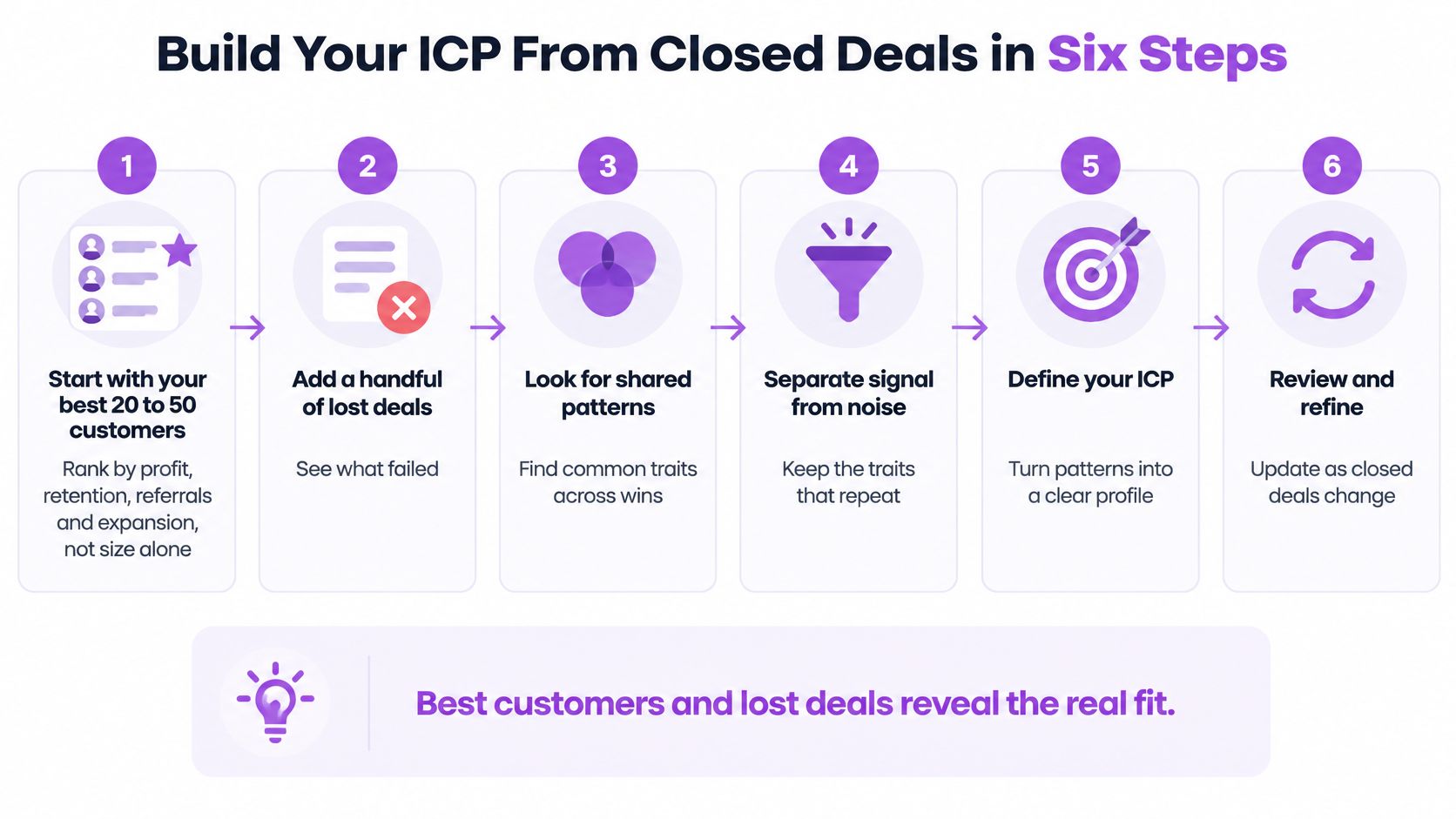
The six steps
Start with your best 20 to 50 customers. Rank them by profit, retention, referrals, and expansion, not size alone. The common slip is starting with biggest logos, which often teaches you who tolerates a long sales cycle, not who succeeds fastest.
Add a handful of lost and churned deals. Look for why they failed: no real trigger, wrong stack, no owner, or painful onboarding. Teams skip this and learn only from survivors.
Record firmographic patterns. Note industry, headcount band, revenue band, geography, and business model. When the pattern breaks, don't force it into one profile. You may have two segments hiding in one list.
Record technographics and triggers. Log the CRM, sales engagement tool, and data sources, plus what made them buy now: a new sales leader, funding, SDR hiring, or a broken prospecting process. Skipping triggers gives you accounts that can buy but have no reason to act.
Write a fit statement and an exclusion list. Two sentences is enough: who this is, and the pain they already feel. Then name who is out, for example companies below the headcount where the pain doesn't exist yet. Most lists keep growing because nobody writes exclusions.
Test on 30 to 50 accounts before scaling. Log reply rate, meeting rate, and qualified opportunity rate by segment. If you can't read the result by segment, the test was too broad.
For teams tightening their list building process, this pairs directly with how you approach sales prospecting in practice, because prospecting quality is set before the first message is written.
Record four signal classes, not just firmographics
Firmographics show whether an account can buy. Need, environment, and post sale outcomes show whether it will buy now and succeed after signing.
| Signal class | Question it answers | Example fields |
|---|---|---|
| Firmographics | Can this account buy? | Industry, headcount, revenue band, country |
| Technographics | Can we fit into their stack? | CRM, sales engagement tool, data provider |
| Behavioral and intent | Will they buy now? | New sales leader, SDR hiring, funding, content engagement |
| Post-sale outcomes | Will they stay and expand? | Onboarding effort, retention, expansion, support load |
Don't weight every field equally. Weight each one by what predicts win rate, cycle length, discounting, churn, and expansion in your own data. That's the difference between a profile document and a prioritization system.
Build segments around need plus ability, not appearance. Use case, urgency, buying model, technical environment, and economics tell you more than a headcount band on its own.
Finish with a one page document a rep can read in five minutes. It should let them decide in one pass: enrich this account, sequence it, hold it, or skip it. If they need a manager to interpret it, it's too vague to use.
Measure Which Segments Deserve Outreach
Volume hides bad fit. A blended reply rate can look acceptable while one segment books meetings and another produces polite replies that never become pipeline. You need segment level economics, not campaign averages.
In the 2019 TOPO survey reported in the PR Newswire account based marketing release, companies with a strong ICP achieved 68% higher account win rates than organizations with weaker ICP discipline, based on more than 150 practitioners at leading account based organizations. The same survey found more than 80% of the most successful account based organizations believed they had a strong ICP, compared with 42% of other organizations.
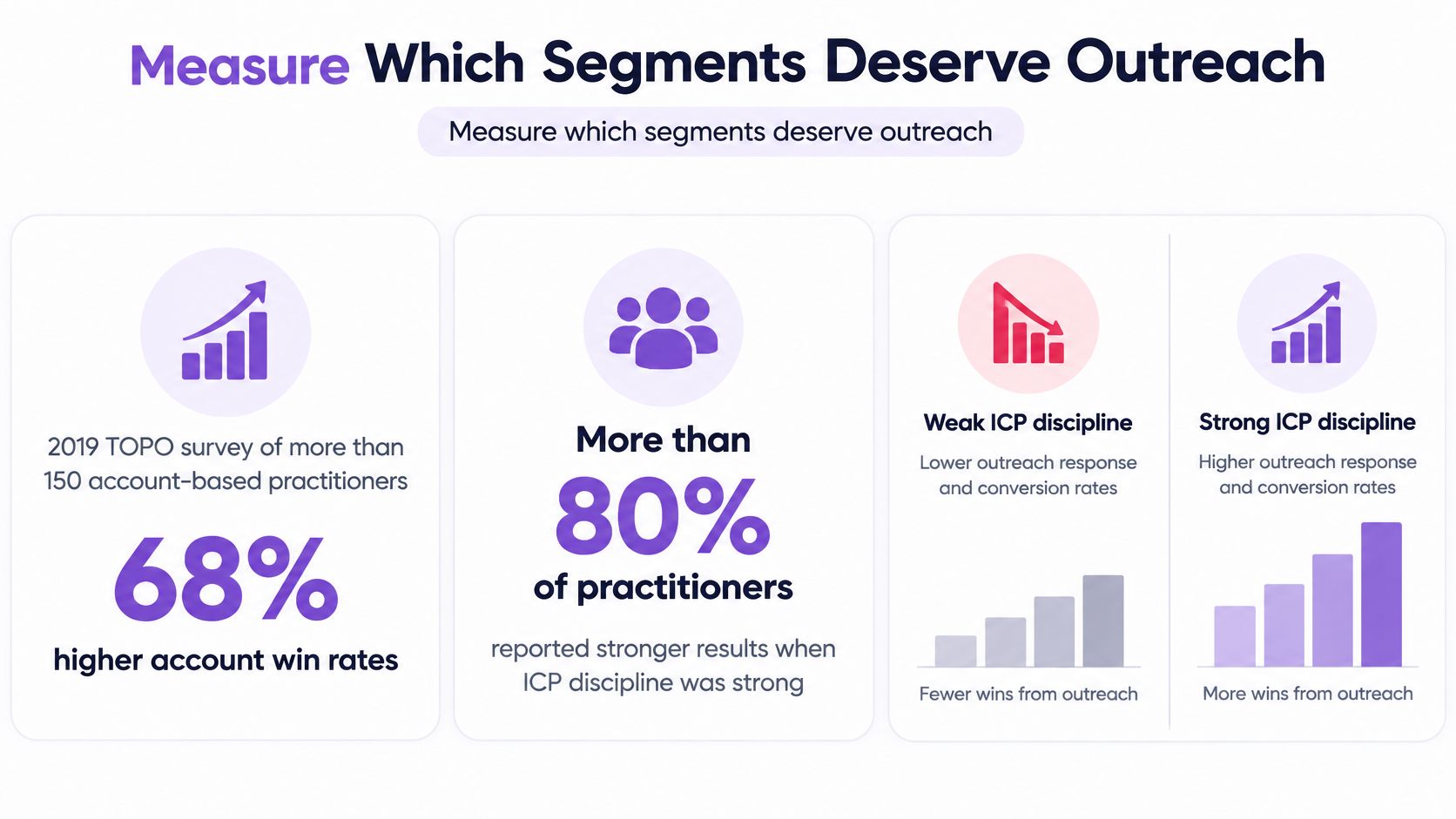
Treat those figures carefully. They're observational and practitioner reported, so they show association, not proof that ICP quality alone causes the lift. They're a reason to test rigorously, not a guarantee.
Rank segments with revenue metrics
Join account, contact, campaign, opportunity, and post sale data first. Then calculate each metric separately for new business, expansion, and renewal cohorts. A segment that converts well but churns or consumes heavy support isn't ideal, it's expensive.
| Metric | How to calculate | What it tells you | Watch for |
|---|---|---|---|
| Win rate | Won deals divided by won plus closed-lost deals | Which segments convert once they reach a deal | Small samples swing widely, so wait for enough closed deals |
| Sales velocity | Opportunities times average deal value times win rate, divided by sales-cycle length | How fast a segment turns outreach into revenue | Long cycles can hide strong segments |
| Retention rate | Customers active at period end divided by customers at period start, per cohort | Whether the segment stays after purchase | Measure by cohort, not across all customers |
| Onboarding effort | Support or implementation hours per account | The hidden service cost of a segment | Often missing from the CRM, so record it manually |
| Reply-to-meeting rate | Meetings booked divided by replies received, by segment | Whether replies become real conversations | High replies with no meetings point to a message or fit problem |
Say you contact 1,000 people from a wide list and 300 from a tight ICP segment as a hypothetical comparison. The smaller list sends fewer messages, but if its reply to meeting rate and win rate are higher, it deserves more capacity. That logic is central to any LinkedIn lead generation strategy that books meetings, and it also applies when you source interest elsewhere, including community channels covered in roundups of Reddit lead generation tools from Bazzly. The channel changes, the segment test doesn't.
Set a minimum number of closed deals before judging a segment. Give high velocity segments more outreach capacity, apply stricter qualification to low win rate segments, and build separate sequences for distinct triggers. Strong replies with weak wins usually signal an offer fit problem, not a copy problem.
Mapping the Buying Group in Each Account
Contacting one executive title and treating a reply as account progress is the fastest way to stall a deal you thought was moving. The person who replies is rarely the only person who can approve, block, or implement what you're selling.
I would define an account level ICP plus a short hypothesis for each role. For every target account, map who signs, who owns the workflow daily, who evaluates technical fit, and who can slow the purchase down.
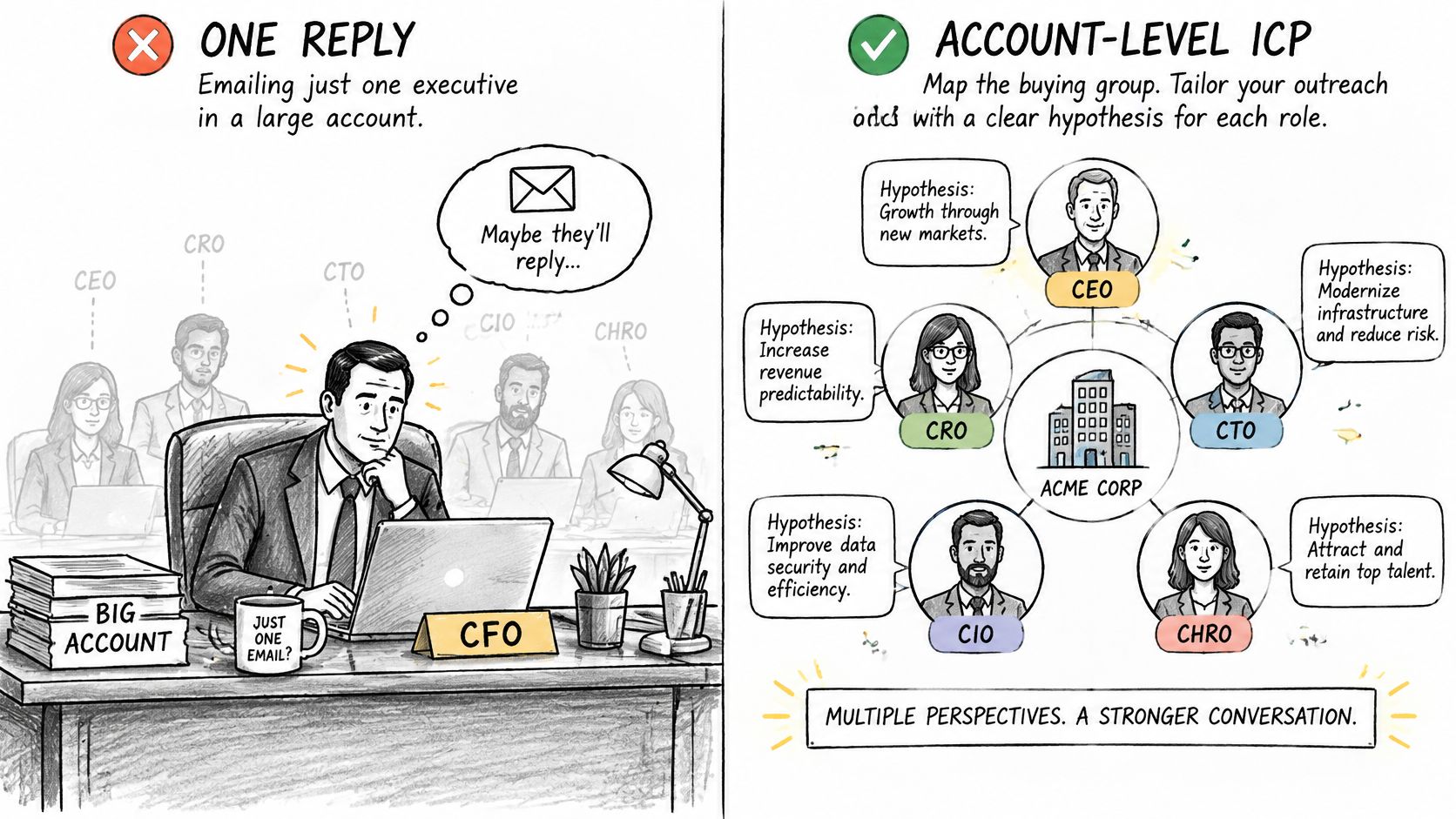
Who to contact and in what order
Lead with the operational owner or economic buyer, the people who feel the cost of the current process. Bring in the technical evaluator when questions about data, CRM sync, or permissions appear. Give the champion something they can forward without rewriting it.
| Role | Main concern | Outreach angle | Signal to log |
|---|---|---|---|
| Economic buyer | Budget and risk to revenue | Short business case with one measurable outcome | Approval step named in call notes |
| Operational owner | Daily workflow and team adoption | How the change affects their week | Reply mentions team size or current tool |
| Technical evaluator | Data access, CRM sync and security | Integration details and data handling | Asks about CRM fields or permissions |
| Champion | Getting internal support | Material they can forward internally | Shares content or introduces a colleague |
| Blocker | Risk, cost or change fatigue | Direct answer to the objection and a clear exit path | Objection logged with its reason |
| Daily user | Time saved on repetitive tasks | Short demo of the workflow | Engages with a how-to or asks for a trial |
Three filters matter most when you first operationalize this in an outreach tool. First, role and seniority: Founders, Heads of Sales, and RevOps leads instead of broad sales titles. Second, company size and stage, for example 11 to 200 employee growth stage B2B companies where the pain is already real. Third, recent activity signals, such as prospects active on LinkedIn or engaging with relevant content, because dormant profiles rarely convert into conversations regardless of title.
Control the trade off
More roles means more volume, and more chances to annoy the same account. Cap active threads, for example three or four contacts per account, and suppress follow ups to anyone who has already replied or opted out. Log roles in the CRM as champion, blocker, evaluator, and approver, so coverage is visible.
High reply volume from one persona can be misleading if the rest of the buying committee remains untouched.
Judge progress by movement across the group, not by one enthusiastic contact. If only a daily user engages and no owner or approver appears, you don't have account penetration. You have interest without a path to purchase.
Compliance Checks Before a Sequence Goes Live
A well defined ICP does not make outreach permitted. Fit tells you who might value the message. It doesn't tell you that you have a lawful basis to contact them, or that your method complies with platform rules.
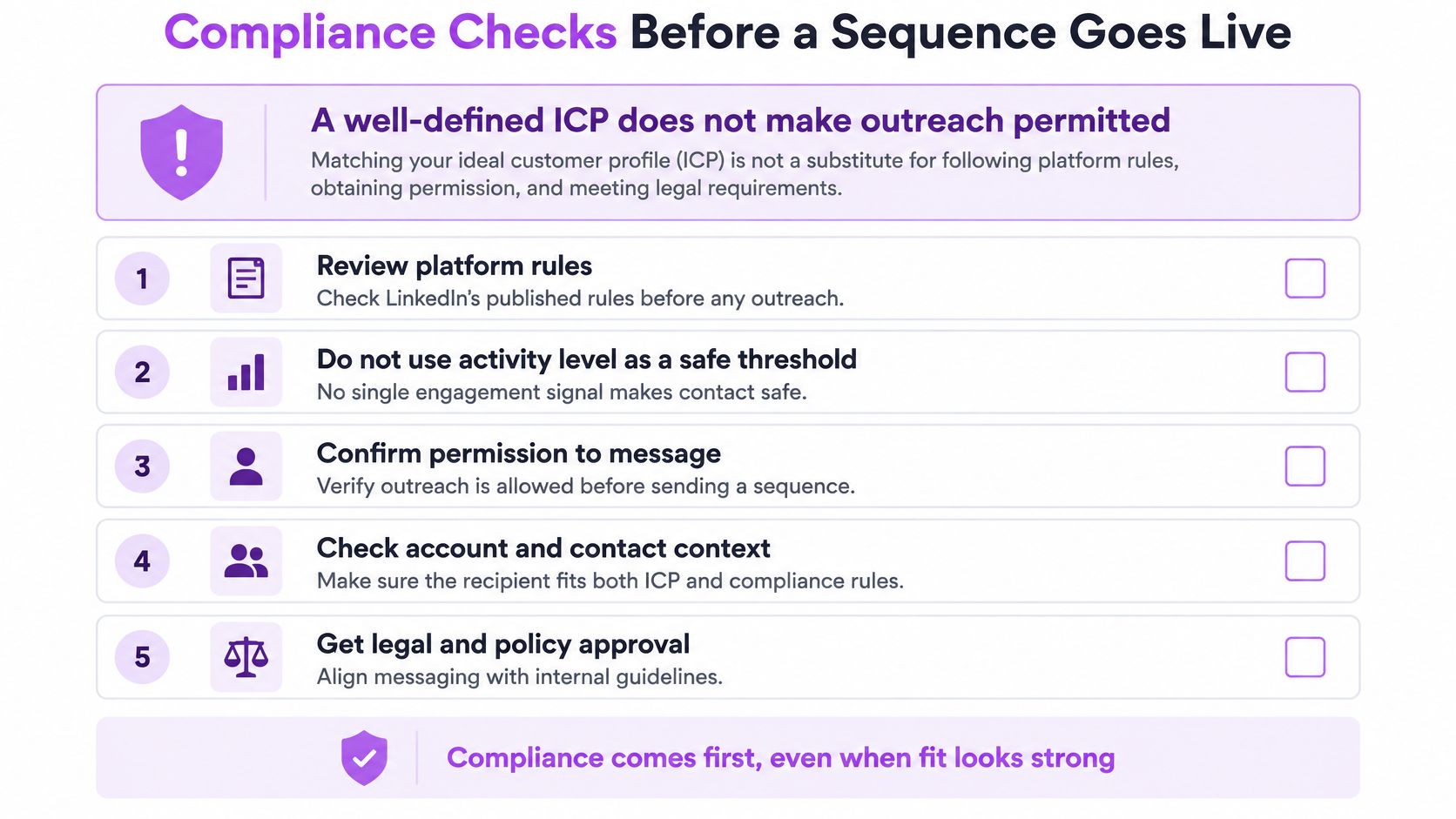
LinkedIn has no safe automation threshold
LinkedIn's guidance on prohibited software explicitly prohibits third party software, crawlers, bots, browser plug ins, and browser extensions that scrape data or automate activity on its website. Its User Agreement also prohibits unauthorized automated methods for adding or downloading contacts, sending or redirecting messages, creating or engaging with posts, and bypassing access controls or usage limits.
Don't present pacing, warm up, or monitoring as a guarantee against restrictions. LinkedIn's stated policy focuses on whether unauthorized automation is being used, not merely on how many actions are performed. Human review of targeting, message quality, account activity, and stop conditions reduces operational risk, but it can't promise account safety.
Email rules change by recipient and jurisdiction
In the UK, the ICO business to business marketing guidance states that the specific electronic mail rule does not apply to corporate subscribers, while marketers must still identify themselves and provide a way for recipients to opt out. That exemption is narrower than unrestricted B2B email. Treating sole traders and individual subscribers as corporate subscribers creates avoidable risk.
For individual subscribers, the ICO direct marketing guidance states consent must be freely given, specific and informed, and demonstrated through an unambiguous indication, unless a qualifying soft opt in applies.
In the US, the FTC CAN-SPAM compliance guide requires accurate From, To, Reply-To, and routing information, prohibits deceptive subject lines, and requires commercial messages to be clearly identified as advertisements. Personalization doesn't remove those duties. If you want a broader rethink of outreach practice, it's worth learning how to rethink cold email beyond mass campaigns before you scale volume.
Pre-launch checklist
Record the basis for contact: Document the source, purpose, segment, and jurisdiction for each list.
Classify recipients: Separate corporate addresses from individual and sole trader addresses before email goes out.
Check message basics: Use a real sender identity, a subject line that matches the purpose, and a working opt out.
Sync opt outs everywhere: Suppress objectors across email, LinkedIn workflows, and CRM records, not in one system only.
Log controls: Record pacing and monitoring as operational controls, never as a guarantee against restrictions.
Name a reviewer: One person signs off targeting, message quality, and stop conditions before launch.
If the basis for contact is unclear, pause that segment and get local privacy advice. A public profile or business purpose isn't automatic permission.
Launch a 30-Day Test With Sample Outreach
Test audience before copy. If you optimize a message for the wrong segment, you'll spend a month improving the wrong campaign.
Write a one page brief first
Include segment name, fit statement, exclusions, buying trigger, target roles, and the metric you'll judge it by. Share it with SDRs, founders, and any agency building the list, so everyone applies the same ICP in sales decisions.
Flowkon plans to release LinkedIn-profile-based ICP creation, audience filtering against that ICP, and an ICP-check node for assessing prospects in a campaign flow within the next few days. Until those features are live, write your ICP criteria down and check prospects against your best customers, exclusions, and buying triggers before building a list. Then set up connection requests, follow ups, and email messages together as one campaign plan any rep can use. That consistency is what makes segment results readable. If each rep invents their own sequence, you can't tell whether the segment or the copy caused the result.
Sample messages for a hiring trigger
Connection note
Hi [First name], I saw your team is adding SDRs this quarter. We work with sales leaders who want follow up to stay consistent while new hires ramp. Open to a short comparison?
First email
Subject: Your SDR ramp plan
[First name], teams that add reps in the same quarter often lose track of which accounts were already contacted. Would a 15 minute call on your current sequence help?
Add your name, company, postal address, and an opt out line to every commercial email. For more angles to test after the audience is proven, see these outreach email examples for sales teams and founders.
Run the test in order
I would test one variable at a time:
Audience first: Send the same message to two ICP slices and see which segment replies and books.
Connection note versus no note: Test only with the winning segment.
First message angle: Compare a pain point opener against a social proof opener.
Follow up timing and count: Compare spacing and total touches last, not first.
Import contacts from the CRM and keep segment tags there. Flowkon integrates with Salesforce, HubSpot, Monday.com, Zoho and Pipedrive, which helps keep contacts and activities aligned with the segment definitions your team already reports on.
Run two or three segments for 30 days, tag every reply and meeting by segment, and keep the test narrow. Pause any segment that raises a compliance concern until it's fixed, even if early replies look promising.
When Your ICP Is Wrong
An ICP doesn't fail loudly. It fails through small mismatches: replies without revenue, meetings without opportunities, and wins that cost too much to serve.
Four warning signs
Strong replies, weak win rate: The message gets attention, but the offer doesn't fit the segment's economics or workflow.
Meetings booked, few opportunities: Your trigger or qualification is wrong. People are curious, not in pain.
Rising onboarding effort: The segment needs more setup, data cleanup, or hand holding than its deal size supports.
Win rate holds, cycles stretch: The trigger is weaker than you assumed, so deals drift without urgency.
Wait until you have enough closed deals in the cohort to judge. Small samples will push you to kill a good segment or scale a bad one.
Kill, narrow, or expand
Kill it when win rate, sales velocity, and retention are all weak in the same cohort. Don't keep rewriting copy for a segment that doesn't retain.
Narrow it when results split. If agencies with multiple client accounts convert but single team companies don't, add that attribute, keep the subgroup, and drop the rest. One hard won lesson from list testing is that cutting a broad list, removing excluded segments, and letting volume fall can hold or raise meetings while wasted outreach drops sharply. Fewer, better matched prospects often outperform a bigger list.
Expand it when win rate and retention hold in a nearby segment. Test that segment with its own brief and sequence, don't widen the original list. Watch enrichment data for surprises too, such as a partner or consultancy vertical, headcount growth, sales hiring, or a specific tech stack predicting replies better than company size, then add that attribute deliberately.
Review every quarter using the same metric definitions and cohort rules. Expect a trade off: removing a segment removes a pipeline source, so reduce capacity gradually and check the pipeline gap before the next review.
An ICP stays useful only as long as your reviews can change it.
Put this into practice with one tight segment, one campaign plan, and reporting that shows meetings and wins by ICP tier instead of raw message volume. Flowkon helps B2B teams run LinkedIn and email outreach from segmented lists with CRM sync and campaign level analytics, so you can test which accounts deserve more capacity. Start with your highest velocity segment and let the next 30 days of data tell you what to scale.