
Sales prospecting is the daily work of finding people who fit your ideal customer profile and starting a real conversation with them, before they ever fill out a form. In practice, that means working a measurable funnel where cold-calling success can sit around 2.3% across more than 204,000 calls, while one email dataset of 16.5 million emails showed a 5.8% average reply rate in 2024, down from 6.8% the year before division50 benchmark.
If you're in SDR, AE, founder-led sales, or agency outreach, that probably sounds familiar already. The hard part isn't defining prospecting; it's doing it in a way that creates meetings without burning lists, inboxes, or your team's time.
The Daily Work of Finding and Starting Real Conversations
Most of us don't prospect in a heroic burst. We prospect in blocks, usually with a rhythm like this, filtering accounts, checking replies, sending follow-ups, and logging outcomes before the day gets away from us. The work is repetitive because the pipeline depends on repetition.
Sales prospecting is not a one-off campaign. It's the recurring operating cadence of identifying the right accounts, finding the right people, and opening conversations that can turn into meetings. That's why SDRs, founders, and AEs all end up living inside some version of the same routine.
Prospecting, lead generation, and cold outreach are not the same thing
Here's the cleanest way to separate them.
DimensionSales ProspectingLead GenerationCold OutreachCore jobFind qualified people and start conversationsCreate interest and capture namesSend the actual message, call, or DMTypical ownerSDRs, founders, outbound repsMarketing, demand gen, content teamsSDRs, AEs, marketing, foundersStarting pointTarget account and persona fitAudience attention and inbound captureA contact list or sequenceOutputMeetings, qualified replies, opportunitiesLeads, form fills, hand-raisersTouchpoints across email, phone, LinkedInRisk if done badlyPoor targeting and wasted effortLots of names, weak fitNoise without context
Lead generation fills the funnel. Prospecting pulls specific accounts through it. Cold outreach is the message layer inside that work. If you want a deeper primer on the terminology, the prospecting definition and techniques from EmailScout are a useful companion piece.
Practical rule: if your team can't tell whether a number is based on replies, meetings, or raw sends, reporting will get muddy fast.
Marketing usually owns lead gen. Sales usually owns prospecting. Cold outreach is the tactic both sides use, but the purpose changes depending on who's doing it. When teams blur those lines, they start arguing about sourced versus influenced pipeline instead of fixing targeting and follow-up.
Why Prospecting Drives Pipeline Growth
Prospecting matters because it's the part of the funnel you can control today. You can't control when a buyer will raise their hand, but you can control who you contact, how relevant the message is, and how consistently you follow up.
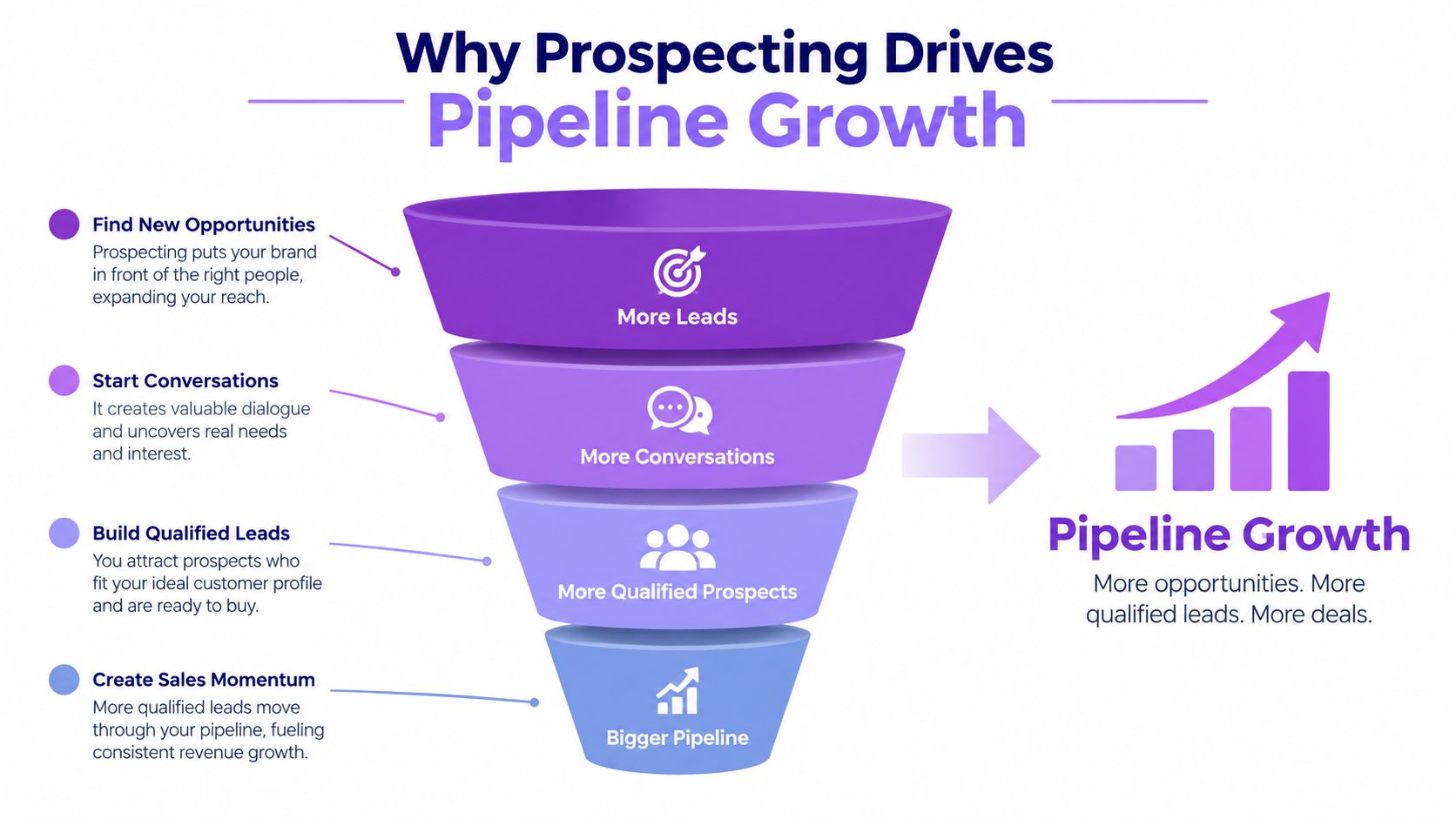
A simple pipeline model makes the point. If 1,000 prospects are researched, 400 accept or engage, 80 reply, 16 meetings get booked, and 3 or 4 turn into opportunities, every layer has to work or the whole thing slows down. That's why vanity numbers like sends or impressions don't pay the bills.
The weakest step usually decides the outcome. If acceptance is fine but replies stall, the list may be okay and the message may be wrong.
For teams that want a more operational view of outbound, the guide to B2B outbound prospecting is a helpful reference point. The core lesson, though, is simple. Prospecting is the only motion that creates demand on a predictable schedule instead of waiting for it.
Optimize the step that leaks, not the loudest metric on the dashboard. That rule saves a lot of bad meetings.
Main Prospecting Channels for B2B Teams
B2B prospecting usually runs across four channels, but not all of them carry equal weight. For most organizations, LinkedIn plus email is the core combination because it gives you reach, context, and a second path when one channel stalls.
ChannelBest ForCostScalabilityExampleOutboundCreating demand with named accountsMedium to high, depending on tooling and laborHigh if targeting is tightCold email to VPs of Sales in your ICPInboundQualifying people who already raised their handLower per touch, but requires marketing supportMediumFollowing up a demo request fastReferralsLeveraging trust that already existsLowLower volume, high qualityAsking a happy customer for a warm introSocial sellingBuilding familiarity before direct outreachLower cash cost, higher time costMediumCommenting, connecting, then DMing on LinkedIn
Outbound works when you need control and volume. Inbound works when marketing already created attention. Referrals are the fastest trust path, but they're not something you can fully schedule. Social selling helps warm up target accounts, especially when the buyer needs to see your name before they'll reply.
Phone still has a place in enterprise, especially when inboxes are crowded and the account is valuable enough to justify the extra effort. The trade-off is obvious, though, because calling is slower and harder to scale than email or LinkedIn.
For teams choosing between channel mixes, this comparison of LinkedIn vs email vs multichannel outreach is worth a look. In most mid-sized teams, a rough split of outbound and social at the top, referral activation in the middle, and inbound follow-up as the smallest slice keeps the motion realistic.
A Five-Step Sales Prospecting Process
Prospecting works best when it's a sequence, not a pile of disconnected tasks. We want each step to make the next one easier, and each touch to move closer to a meeting.
1. Set up the workspace and define the target
Start with the ICP, then build a target list by segment. In real life, that means deciding which industries, company sizes, and buyer roles are worth your time, then splitting the list so each rep owns a clear slice.
2. Build and enrich the lead list
A good list includes role, industry, and verified business emails. If the contact data is weak, everything downstream gets worse, so enrichment isn't admin work, it's pipeline hygiene.
3. Build a multichannel campaign
One touch isn't a sequence. A practical flow often looks like email, LinkedIn connection request, follow-up email, then a second channel touch that adds a different angle or new context.
4. Personalize each message and keep pacing sane
Personalization should come from a trigger, role, or company context, not just a first name merge. If there's a funding event, hiring push, tool change, or public initiative, that gives the message a reason to exist.
Useful test: if you remove the prospect's name and company and the email still works, the message is probably too generic.
5. Manage replies in one inbox and sync to CRM
The end of the workflow matters as much as the start. Same-day logging, clean dispositions, and clear handoff notes keep forecasting honest and prevent duplicate outreach from the next rep.
For teams that want this kind of operating system in one place, Flowkon is one option, with multichannel campaigns, lead enrichment, a centralized inbox, and CRM sync. The point isn't the tool itself, it's that the process should feel like one motion from list to reply to meeting.
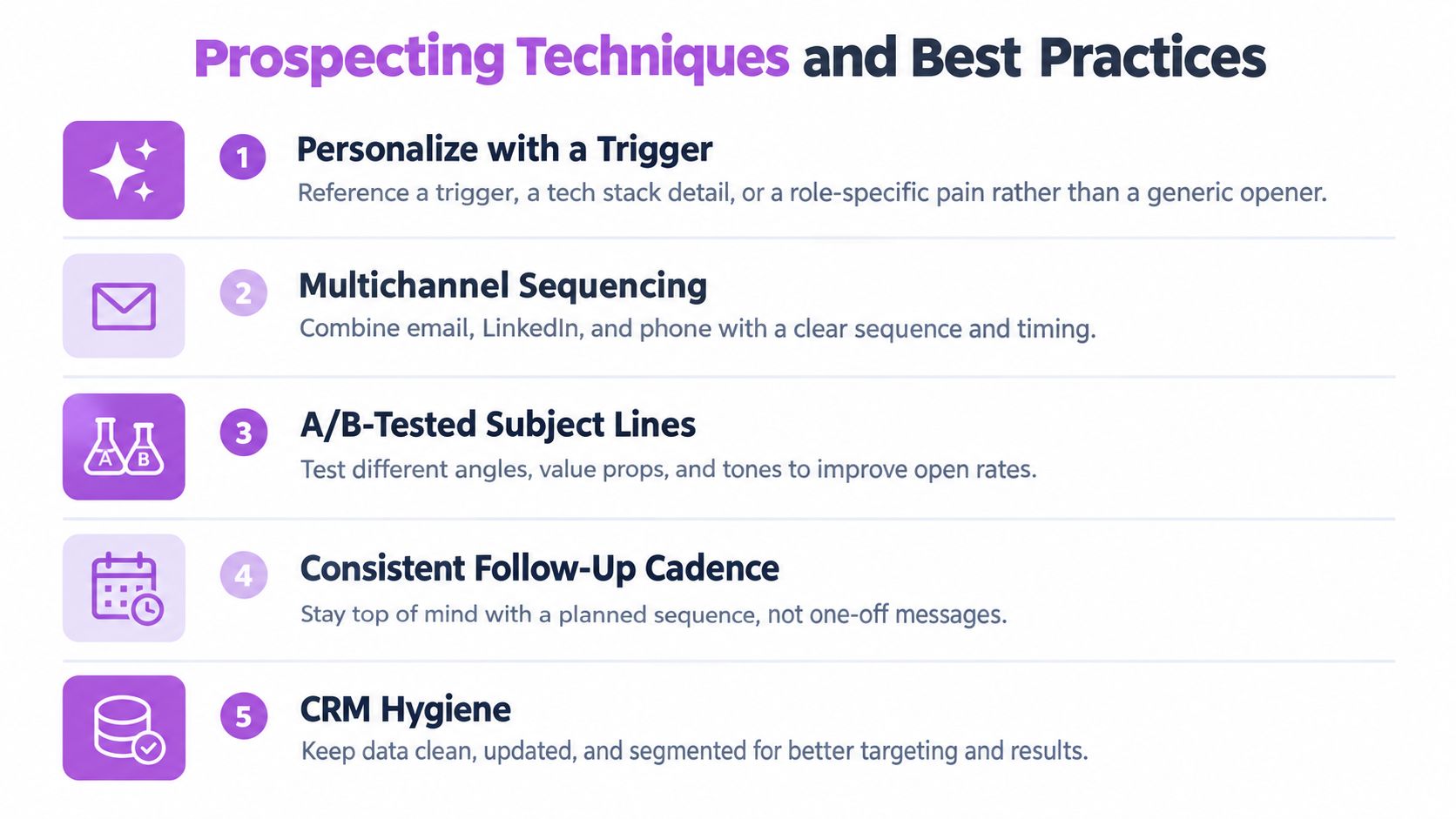
Prospecting Techniques and Best Practices
The technique that usually separates strong teams from average ones is relevance. Not cleverness, relevance.
Personalization now means referencing something concrete, like a trigger event, a stack detail, or a role-specific pain. A first name and a company name aren't personalization anymore, they're mail merge. The message has to make the buyer feel that we understand their context.
The habits that keep reply rates alive
- Use a trigger in the opener. A hiring push, launch, funding event, or role change gives the outreach a reason to land.
- Follow up more than once. Most B2B replies arrive after the first touch is already forgotten, so one polished email is rarely enough.
- Mix channels. Email, LinkedIn, and phone work better together because each one catches a different attention pattern.
- Stay within safe daily limits. Keep connection requests and sends at a human pace instead of trying to brute-force volume.
- Review weekly. If replies stay flat, change the message, segment, or timing before you blame the channel.
I'd rather see a team send fewer, better touches than flood the market with generic ones. The cost of sloppy sequencing is usually hidden at first, then it shows up as poor-fit meetings and dead inboxes.
A Real Example of Scaling Multichannel Prospecting
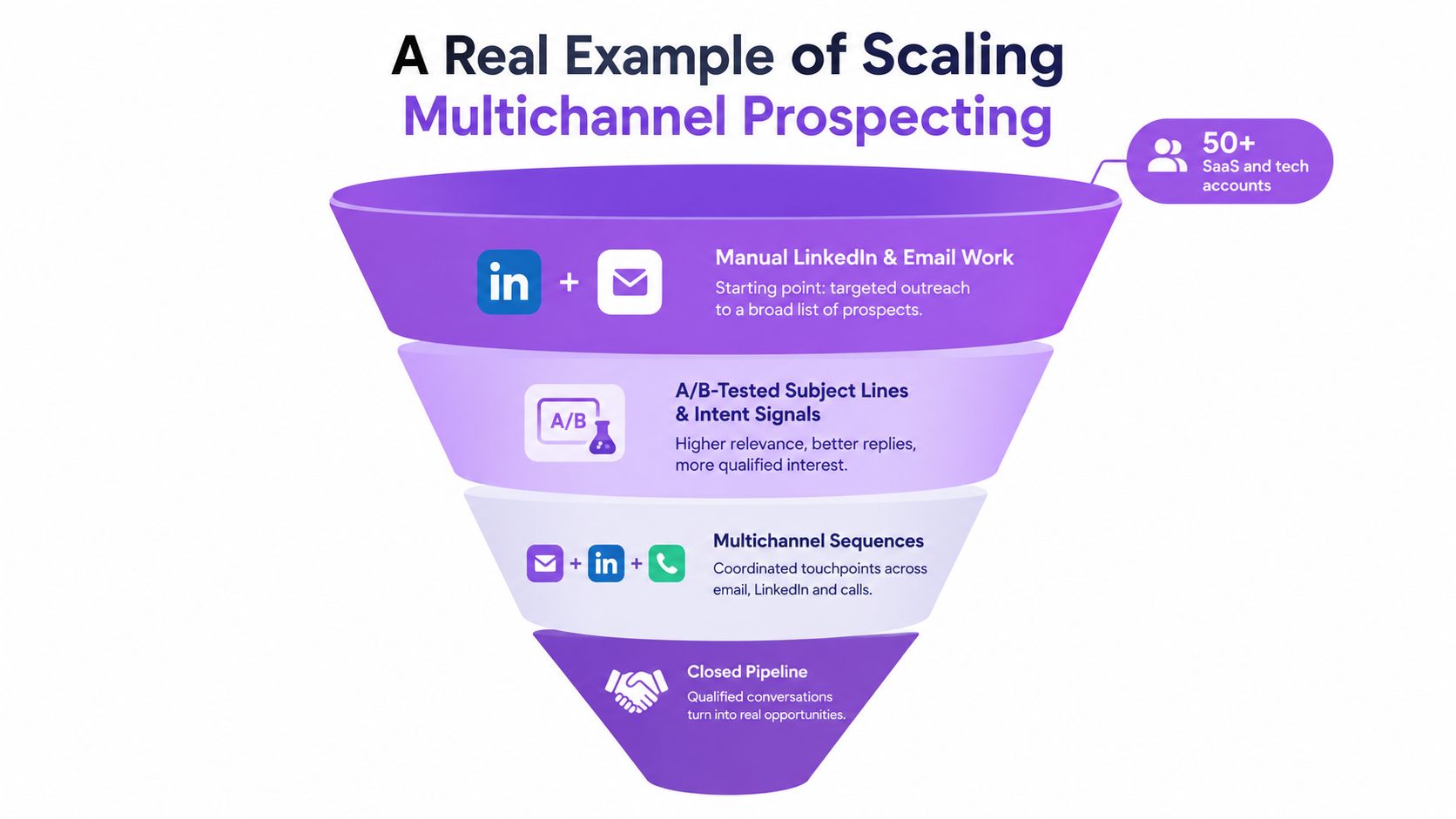
Sales Focus Inc. shows what changes when prospecting outgrows manual account management. The team consolidated outreach across multiple accounts, automated routine follow-ups, and kept reps responsible for responding when prospects engaged. That workflow reduced administrative work at the top of the funnel and gave sellers more time for qualified conversations.
The reported result was nearly 400% pipeline growth, described as a close to fivefold increase after the workflow change in the Sales Focus Inc. streamlined multichannel outreach for its sales team customer story.
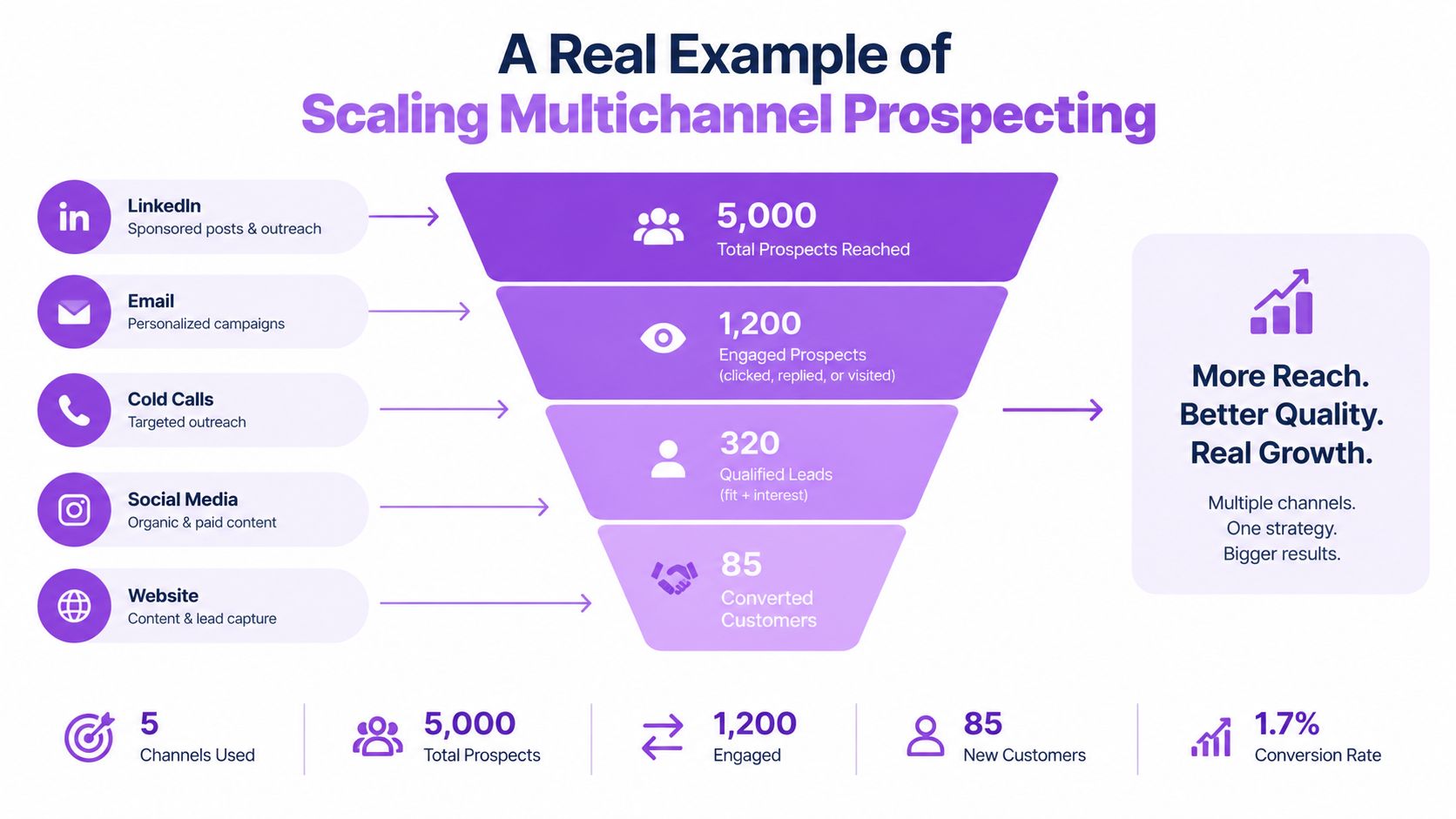
The operating lesson is straightforward. Let a system handle scheduled touches and account organization, then move human attention to replies, objections, and buying context. Automation supports prospecting capacity, while judgment still determines which conversations become opportunities.
Metrics to Track and Which One Matters Most
The cleanest prospecting dashboards usually revolve around three numbers, connection acceptance rate, reply rate, and meetings booked. Volume still matters, but mostly as a guardrail, because a team that sends too little won't create enough conversations to matter.
KPIWhat it measuresHealthy B2B benchmarkFunnel layer it validatesConnection acceptance rateWhether targeting and profile fit are credibleNo universal benchmark, but higher is betterList quality and relevanceReply rateWhether the message makes people respondNo universal benchmark, but it's the clearest relevance signalMessage, timing, sequenceMeetings bookedWhether replies turn into sales conversationsNo universal benchmark, but this is the business outcomeOpportunity creation
Reply rate is the one I watch most closely. Acceptance rate tells me whether the list and profile are on target, and meetings booked tell me whether the motion is turning into pipeline, but reply rate shows whether the message resonates.
Teams often hurt themselves with the same patterns:
- Generic blasts. One message sent to everyone usually fits no one.
- No follow-up. A sequence that stops after one or two touches dies too early.
- Manual tracking. Spreadsheet updates lag, and the next rep repeats work.
- Separate LinkedIn and email campaigns. The buyer experiences one conversation, not two unrelated ones.
- Ignoring the data. If reply quality drops, the problem is usually list, message, or timing, not “the market.”
For a deeper look at what to watch in the dashboard, the dashboard and analytics feature is the kind of reporting layer that keeps prospecting from turning into guesswork.
Tools for Sales Prospecting and Where Flowkon Fits
Most prospecting stacks fall into four buckets. You've got sourcing tools like Apollo, ZoomInfo, and Lead411. You've got sequencing tools like Outreach, Salesloft, Lemlist, and Instantly. You've got enrichment and intent tools like Clearbit, Bombora, and 6sense. Then you've got unified workspaces that try to pull the daily workflow into one place.
That last category is where teams usually make their first practical decision. A point solution goes deep on one task, but an all-in-one workspace is often faster to adopt when the team mainly works LinkedIn and email together. Flowkon sits in that unified-workspace bucket alongside tools built to keep sourcing, sequencing, inbox management, and CRM sync inside one operating flow.
The trade-off is simple. Point tools can be stronger in one area, but unified tools reduce tab-hopping and data decay. For many teams, that's the better starting point.
If you want a cleaner way to run LinkedIn and email prospecting without losing track of replies, sequence steps, or CRM updates, take a look at Flowkon. It's built for multichannel outreach, centralized replies, enrichment, and team workflows, and the 7-day free trial is a straightforward way to see whether that structure fits how your team already sells.