

A prospect opens your email, sees a name they don't recognize and a long paragraph about your company, then closes it. You had a reason to contact them, but they never reached it.
A strong introduction email makes that reason clear. Tell the reader who you are, why you chose them, and what small next step you're asking for. They should be able to answer without researching your company or opening a deck.
The right message depends on the relationship. A cold prospect needs evidence of relevance. A new client needs clarity about ownership. Someone who accepted your LinkedIn request needs an honest continuation, not a claim that they've shown buying intent.
Choose the example below that matches what you can verify. Keep the structure, replace the details, and remove anything you couldn't defend if the recipient asked about it.
1. Introduce Yourself Email Example 1 Without an Existing Relationship
If you're contacting a prospect cold, lead with why this person, not your company history. Use a verified business observation, then connect it to the work you do.

Subject: Supporting {company}’s partner launch
Hi {first_name},
I saw {company} announced {partner_program}. I'm {your_name} from {your_company}, and I help sales teams build outreach for new partner programs.
Is partner recruitment part of your remit?
Thanks,
{your_name}
This cold introduction email answers the questions that matter: who you are, why them, why now, and what happens next. The closing question checks ownership before asking for someone's calendar.
What to check before sending
- Verify the trigger. Read the announcement rather than relying on a scraped summary.
- Keep the connection narrow. A partner launch doesn't prove the company needs help with every sales problem.
- Cut empty praise. “Impressive company” gives the reader no useful context.
This approach fails when the observation has nothing to do with your offer. Fix that connection before adding more personalization, as explained in why personalized messages can still feel automated.
For a broader editing reference, use the guide to write better business emails with VoiceType. Keep the final message in language you'd naturally use.
2. Introduce Yourself Email Example 2 With Genuine Mutual Context
A shared community gives you a reason to introduce yourself. It doesn't permit you to imply a referral.
Use this self introduction email when you share a professional group, customer segment, event, or public discussion.
Subject: Your point about {discussion_topic}
Hi {first_name},
We're both in {community}, where you mentioned {accurate_summary_of_point}. I'm {your_name}, and I work with {customer_segment} on {relevant_work}.
We're considering a similar approach to {specific_issue}. Would you be open to comparing notes?
Best,
{your_name}

Keep the shared context accurate. If you're paraphrasing a post, preserve the person's meaning rather than bending it toward your pitch.
Knowing the same person isn't the same as being introduced by that person.
If a mutual contact suggested reaching out, say so. Otherwise, explain the connection without borrowing their endorsement. The same distinction matters in business referral etiquette for licensing opportunities.
This version fails when “comparing notes” disguises a sales pitch. If you want to discuss a service, state the business purpose rather than arranging a conversation under false pretenses.
3. Introduce Yourself Email Example 3 After a LinkedIn Connection
An accepted connection request is a real touchpoint. It isn't a request for a demo. Continue from what happened, without upgrading a connection into a conversation.
A continuation, not a fresh pitch
Subject: Following up on LinkedIn, {first_name}
Hi {first_name},
Thanks for connecting on LinkedIn. I'm {your_name} from {your_company}, where I work with {relevant_team_type} on {specific_outcome}.
I noticed you lead {function} at {company}. Is {relevant_priority} something your team is working on?
Thanks,
{your_name}
If you discussed a topic, replace the generic connection reference with that discussion. If they only accepted your request, don't write “great chatting.”
A Flowkon outreach example uses the subject “Quick question, {first_name}” and asks whether improving outreach is a priority that quarter. That's a useful low-pressure structure, but the LinkedIn version should still acknowledge the actual touchpoint.
Before sending:
- Check both channels. Don't email a pitch they've already answered in a LinkedIn message.
- Respect refusals. Stop prospecting follow-ups after a decline.
- Keep context consistent. Don't describe different offers across channels.
Use a combined LinkedIn and email sequence to plan the handoff. LinkedIn automation carries account-restriction risk, and pacing or monitoring doesn't guarantee safety or official approval.
4. Introduce Yourself Email Example 4 for an Agency or Freelancer
A launch is observable. A conversion problem usually isn't. Separate what you saw from what you suspect when introducing your services.

Subject: Copy support for {product_launch}
Hi {first_name},
I saw {company} launched {product}. I'm {your_name}, a freelance copywriter focused on {relevant_specialty}.
If launch-page messaging is still being refined, I can help with {specific_deliverable}. Would a relevant writing sample be useful?
Best,
{your_name}
The conditional wording matters. You're offering help if the need exists, not declaring that their launch is underperforming.
Keep the service and evidence specific
- Confirm the timing. An old launch announcement isn't a current buying signal.
- Offer real work. Share a relevant sample only if you have one.
- Skip fake urgency. Don't invent a deadline to force a response.
For larger prospect lists, Flowkon's personalized variables can insert verified company and role details. Preview populated messages and exclude incomplete records rather than sending broken placeholders.
This approach fails when the trigger is merely decorative. An agency outbound workflow should connect the observed initiative to a service you can deliver, not attach the same offer to every announcement.
5. Introduce Yourself Email Example 5 for a Potential Partner
“Explore synergies” leaves the recipient to invent the opportunity. Suggest a collaboration they can evaluate instead.
For example, a specialist agency and a software provider might serve the same customer type without offering the same service. That's a starting point, not proof that a partnership makes sense.
Subject: Joint workshop on {customer_problem}
Hi {first_name},
I'm {your_name} from {your_company}. We help {shared_customer_type} with {your_specialty}, while your team focuses on {their_verified_specialty}.
Would you be open to discussing a joint workshop about {specific_customer_problem}?
Best,
{your_name}
Practical rule: Propose something small enough to assess without committing either company to a commercial agreement.
Before sending, check whether the recipient already provides a competing service. If their responsibilities are unclear, replace the workshop question with an ownership question: “Who handles educational partnerships at {company}?”
Don't promise access to customers, distribution, or revenue you can't provide. If the recipient expresses interest, agree on audience, preparation, lead handling, and follow-up responsibilities before promoting anything.
This introduction fails when the benefit is entirely yours. Explain what their customers would gain, and leave room for the other team to decide whether the idea deserves a test.
6. Introduce Yourself Email Example 6 for a New Client or Account Handoff
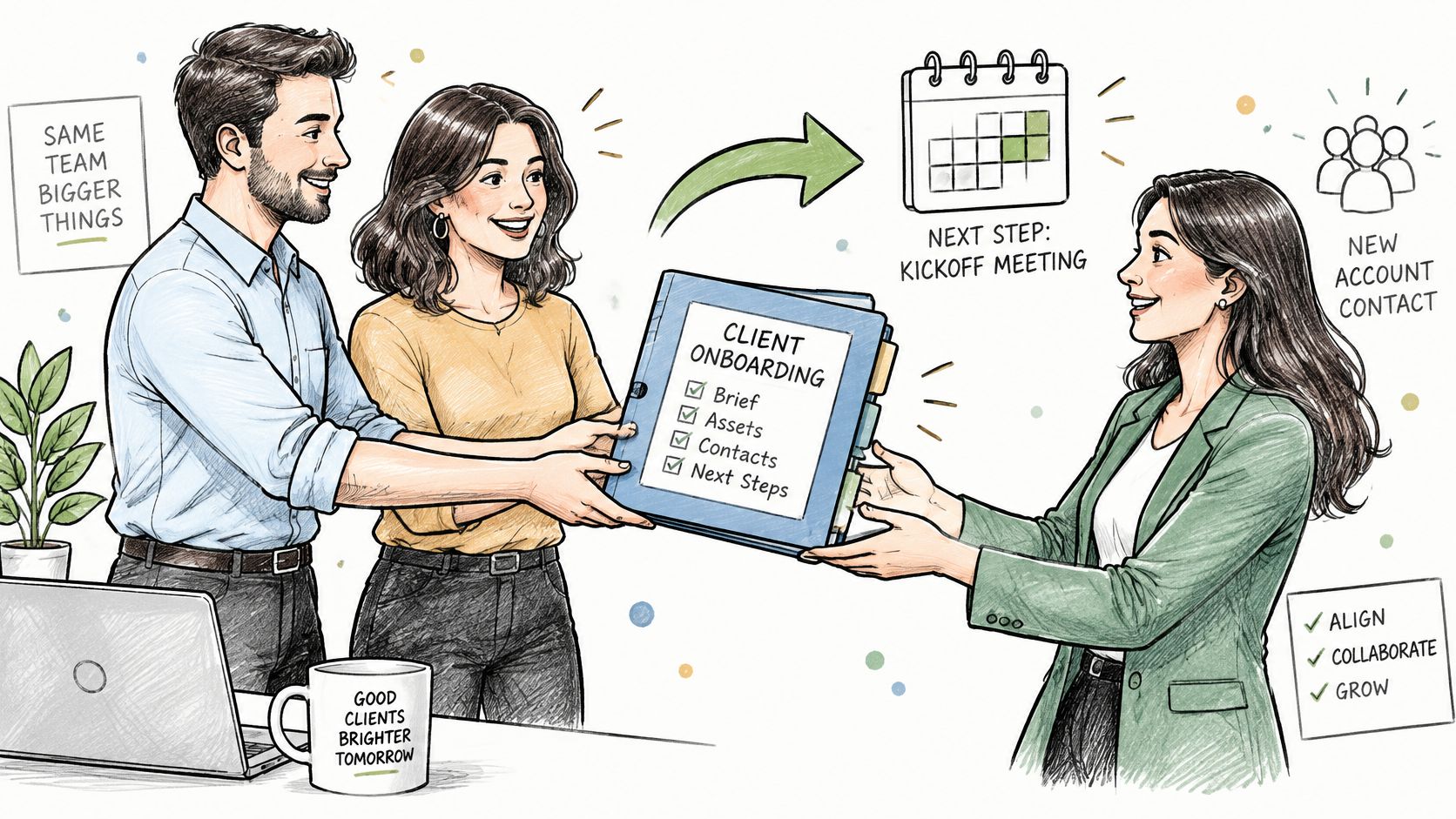
A new client doesn't need another sales pitch. They need to know who owns the work and what happens next.
Subject: Your contact for {project_name}
Hi {first_name},
I'm {your_name}, your {role} for {project_name}. I'll handle {agreed_responsibilities}, while {existing_contact} remains responsible for {their_responsibilities}.
Our next agreed step is {next_step} on {confirmed_date}. Is there anyone else who should join that discussion?
Looking forward to working together,
{your_name}
This introduction email to a client should match the actual handoff. Have the existing contact introduce you in the same thread when practical, so the customer doesn't have to verify the change themselves.
Prevent ownership confusion
- Confirm responsibilities. Name what you own and what remains with someone else.
- Check dates. Don't present a proposed meeting as confirmed.
- Preserve scope. An introduction isn't the place to slip in unapproved changes.
For a new colleague, adapt the same introduction email sample around your remit, shared work, and preferred contact method. Replace the customer next step with a relevant internal question.
This version fails when it sounds reassuring but leaves the customer unsure whom to contact. Be explicit, even if that makes the email slightly longer.
7. Introduce Yourself Email Example 7 for a Recruiting Client
A hiring post gives you a reason to reach out, but it doesn't confirm the company accepts agency submissions. Verify the role and submission process first, then contact the person responsible for recruiting or procurement.
For a prospective employer, connect your specialty to the specific vacancy. Don't claim you have candidates ready unless you do.
Subject: Recruiting support for {role_title}
Hi {first_name},
I'm {your_name} from {agency}. We recruit for {relevant_specialty}, and I noticed {company} is hiring a {role_title}. Are you open to external support for this search?
Thanks,
{your_name}
Before sending, check the posting for agency restrictions and confirm you have the right contact. A focused message to the appropriate owner is more useful than emailing several managers whose responsibilities you haven't verified.
Keep representation honest
- Don't invent a shortlist. A specialty match doesn't mean suitable candidates are available.
- Protect candidate details. Get authorization before sharing identifying information.
- Make candidate outreach specific. Name the role, explain how you found it, and connect one verified detail from their experience to the opening.
For example: “Hi {first_name}, I'm recruiting for a {role_title} at {company}. Your experience with {verified_skill_or_project} looks relevant to the role. Would you be open to hearing more?” Confirm the detail and the role are accurate before sending.
This approach fails when you treat a public vacancy as permission to bypass the employer's stated process.
8. Introduce Yourself Email Example 8 When There's No Reply
A useful email follow-up makes the original message easier to answer. It doesn't criticize the recipient for being busy.
Subject: Keep the existing thread
Hi {first_name},
Following up on my note about {verified_initiative}. The part I can help with is {narrow_deliverable}, rather than {broader_scope}.
Would a short outline be useful?
Thanks,
{your_name}
Use the clarification only if it adds something meaningful. “Just checking in” gives the reader no new reason to respond.
Silence isn't permission to keep contacting someone indefinitely.
Choose timing around the business situation. A warm referral with an agreed next step calls for different judgment from an unsolicited cold introduction.
A sales outreach analysis covering follow-ups reported 4.9% replies for campaigns with follow-ups versus 3.0% without. That supports testing follow-ups, not assuming a fixed cadence works for every audience.
Measure positive replies and qualified conversations, not opens alone. When testing, change the opening or closing question while keeping the audience, offer, and sending conditions comparable.
This message fails when the “smaller ask” is another route to the same unwanted pitch. Stop after a refusal, honor opt-outs, and don't switch channels to bypass a clear no.
Which introduce yourself email fits which situation
ItemBest ForTypical AskMain RiskRelevance-First Cold IntroductionFirst-touch outreach to a prospect whose responsibilities match your solutionAsk whether they are reviewing the problem area this quarterGeneric observations or a problem outside the recipient's remitMutual-Context IntroductionOutreach to people in an overlapping professional communityAsk whether they are exploring a relevant approach or discussing the broader marketA weak connection may feel manufactured or imply an unearned referralFollow-Up After a LinkedIn ConnectionMoving an existing LinkedIn interaction into an email conversationOffer a short outline related to the interactionAssuming a connection acceptance signals buying interestTrigger-Based Agency or Freelancer IntroductionIntroducing a specific service to a potential clientOffer a brief outline for a workstream tied to a visible initiativeThe initiative may already have an owner, or unsupported criticism may harm credibilityPartnership IntroductionApproaching a complementary business about collaborationAsk whether they are the right person to discuss a small pilotAudience overlap may not create mutual value, or the workload may be unevenNew Client or Account HandoffCustomer onboarding, account changes, or delivery-team introductionsConfirm the next agreed step and request any necessary inputUnclear responsibilities or overlooked prior commitmentsRecruiter or Hiring-Partner IntroductionRecruiters contacting hiring managers or talent leadersAsk whether hiring is handled in-house or external support is welcomeOpen vacancies do not necessarily indicate agency demandUseful Follow-Up When There Is No ReplyFollowing up on a relevant first-touch emailOffer a short written outline or invite the recipient to close the loopRepeated messages cannot fix poor targeting and may damage trust
Pick One Template, Test It Small, Then Scale
Choose the introduce yourself email that matches your strongest existing context. That might be a verified company trigger, a shared community, an actual LinkedIn interaction, or an agreed client handoff.
Don't combine every approach into a heavily researched paragraph. Use the minimum relevant context the reader needs to understand why you're contacting them and answer the question.
Review the populated message, not just the template
- Identity. Use a recognizable sender name, professional address, and clear signature.
- Evidence. Verify observations, referrals, dates, and responsibilities.
- Fields. Check every placeholder and remove records with missing or questionable data.
- Ownership. Confirm who should receive the message and who on your team handles replies.
- Next step. Ask something a busy reader can answer in a line.
For commercial introductions in the U.S., remember that CAN-SPAM applies to B2B email too. The FTC's commercial email compliance guide requires accurate sender information and subject lines, advertisement identification where required, a valid physical postal address, and a clear opt-out method.
Don't assume those U.S. requirements settle international outreach rules. Review the requirements for the markets you contact before scaling.
Test the decision, not just the wording
Send to a small, comparable segment and review the actual replies. Did recipients understand the offer, recognize the relevance, and know what you wanted them to do?
Change a single element, then confirm the pattern with another batch before expanding. If people repeatedly say you've contacted the wrong owner, fix targeting before rewriting the subject line.
The next step is simple: choose a template, replace every placeholder with verified information, and read the finished email as the recipient would.
Flowkon combines LinkedIn and email campaigns with personalized variables, scheduling, tracking, and a centralized inbox. Start your 7-day free trial with Flowkon and test an introduction-and-follow-up workflow on a focused prospect segment.