
You sent the connection request on Tuesday, they accepted on Thursday, and the follow-up is still in your head. The note you almost sent was the same pitch as last month. A LinkedIn lead generation strategy is a repeatable path from a defined account list to a qualified conversation. It is not permission to send more.
Why a LinkedIn Lead Generation Strategy Beats Random Outreach
Random outreach breaks in three places. The same pitch shows up on LinkedIn and in email. A profile view never connects to the note you write a week later. Replies, when they happen, never get counted, so next week copies this week.
Founders, SDRs, sales managers, and agency operators already feel it. Acceptance stays low. Replies stay rare. Follow-ups slip. Notes sound generic because they were written for a job title, not a person.
Showing up is not pipeline. LinkedIn Marketing Solutions cites Wpromote's State of B2B Marketing Report: 89% of B2B marketers use LinkedIn for lead generation, while 62% say the platform generates leads for them, and that lead-generation figure is more than twice the next-highest social channel. The 27-percentage-point gap is the point. Nearly nine in ten teams are present. Far fewer can point to leads.
Practical rule: If you cannot name the next step after an acceptance, you have a habit, not a strategy.
What changes when the sequence is defined
The work has to live outside anyone's memory.
- A named list: You know who is in this week and who stays out.
- A credible profile: The buyer sees an outcome before the request.
- A warm-up: A visit or a relevant like happens first.
- Short notes: The request does not pitch, and the follow-up is on a calendar.
- A Friday read: Acceptance, replies, and meetings decide next week's copy.
- A branch: Silence on LinkedIn can move to email without restarting the pitch.
Product-specific buyer signal insights help you choose which accounts deserve that sequence, especially when a job post, a tool change, or a recent comment is the only reason to write this week.
Define the Buyer and Build a Tight Lead List
Start with the company, then the person. Cut by industry, geography, and company size before you touch a title. Then filter seniority and function, and keep a buying signal you can name: hiring, a tool change, or a post from the last few weeks.
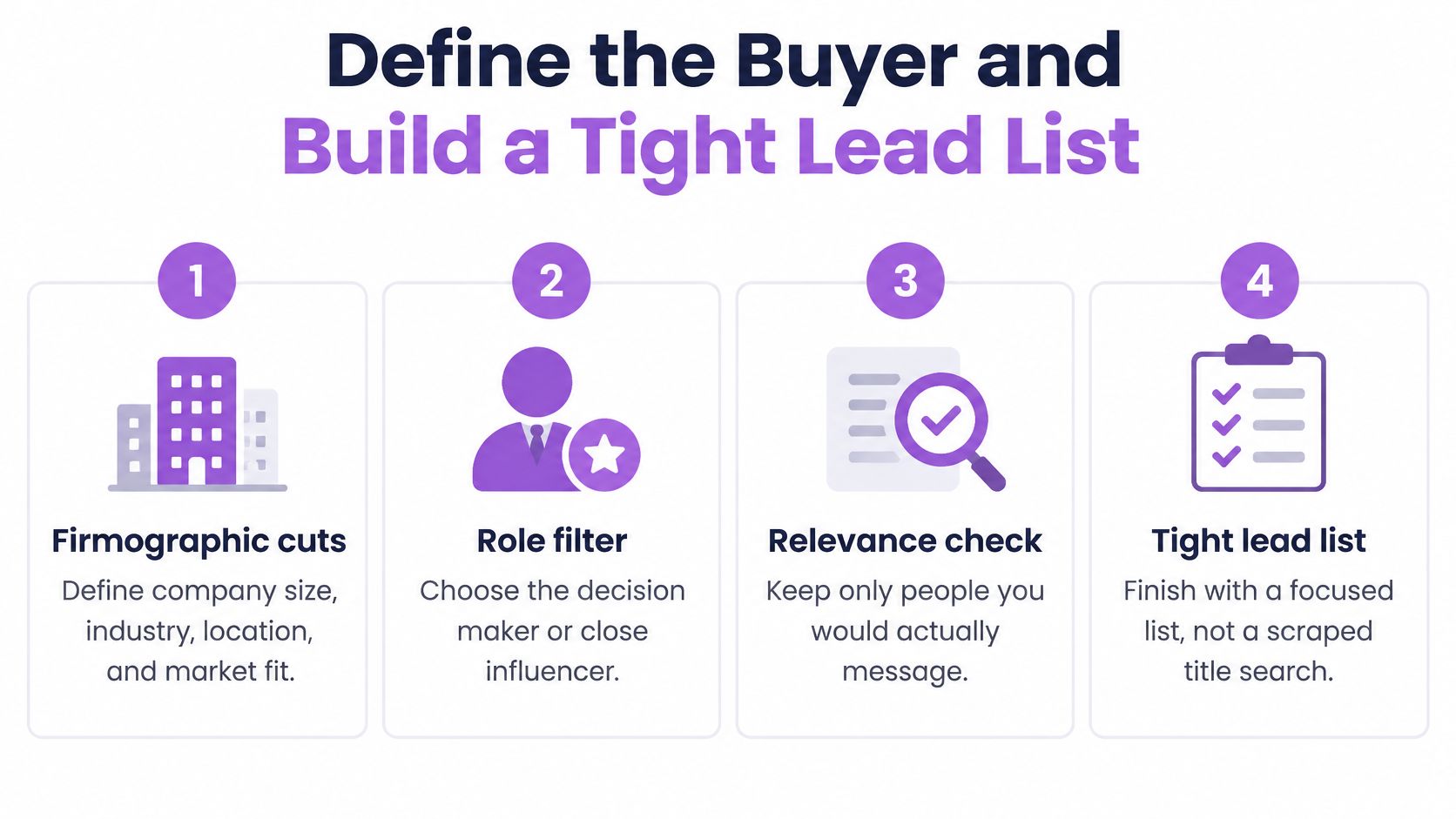
A buying committee is not a license to message the whole account. LinkedIn's buyer-journey research found that social media and information sharing inside the buyer's organization ranked among the top three content sources across all five purchase stages. The same research reports that 75% of prospective buyers say thought leadership helps decide which vendors reach the shortlist, and 70% regard LinkedIn as a trusted information source. People compare notes internally. Your job is still a short list.
Who gets a message this week
Pick one economic contact. Add one technical or operational contact only when the account is worth a second thread, and write a different reason for each. The CFO cares about wasted spend. The ops lead cares about a broken handoff. If both notes could be swapped, you are not ready.
Write a one-line value hypothesis per segment before anyone opens a compose box. "We help 50 to 200 person SaaS teams stop losing accepted connections" is enough. Later notes should pull from that line, not from improvisation.
Source from Sales Navigator, LinkedIn search, or a CSV. Then clean the file. Drop duplicates, drop stale titles, and verify a business email before any email step exists. Flowkon's email finder is one place that check can happen before launch. Agencies should keep each client in a separate workspace so one client's prospects never land in another's sequence.
Pass or fail before import
- Why this person: You can say the role and the signal in one sentence.
- Why this week: The signal is current, not a title from last year.
- Why not their teammate: A second contact has a different risk, or they stay off the list.
- Clean row: No duplicate, no dead title, no guessed email waiting for a later step.
If you cannot say why this person, this week, the row stays out.
Make the Profile Credible and Warm the Prospect First
The list decides who sees you. The profile decides what they conclude in ten seconds.
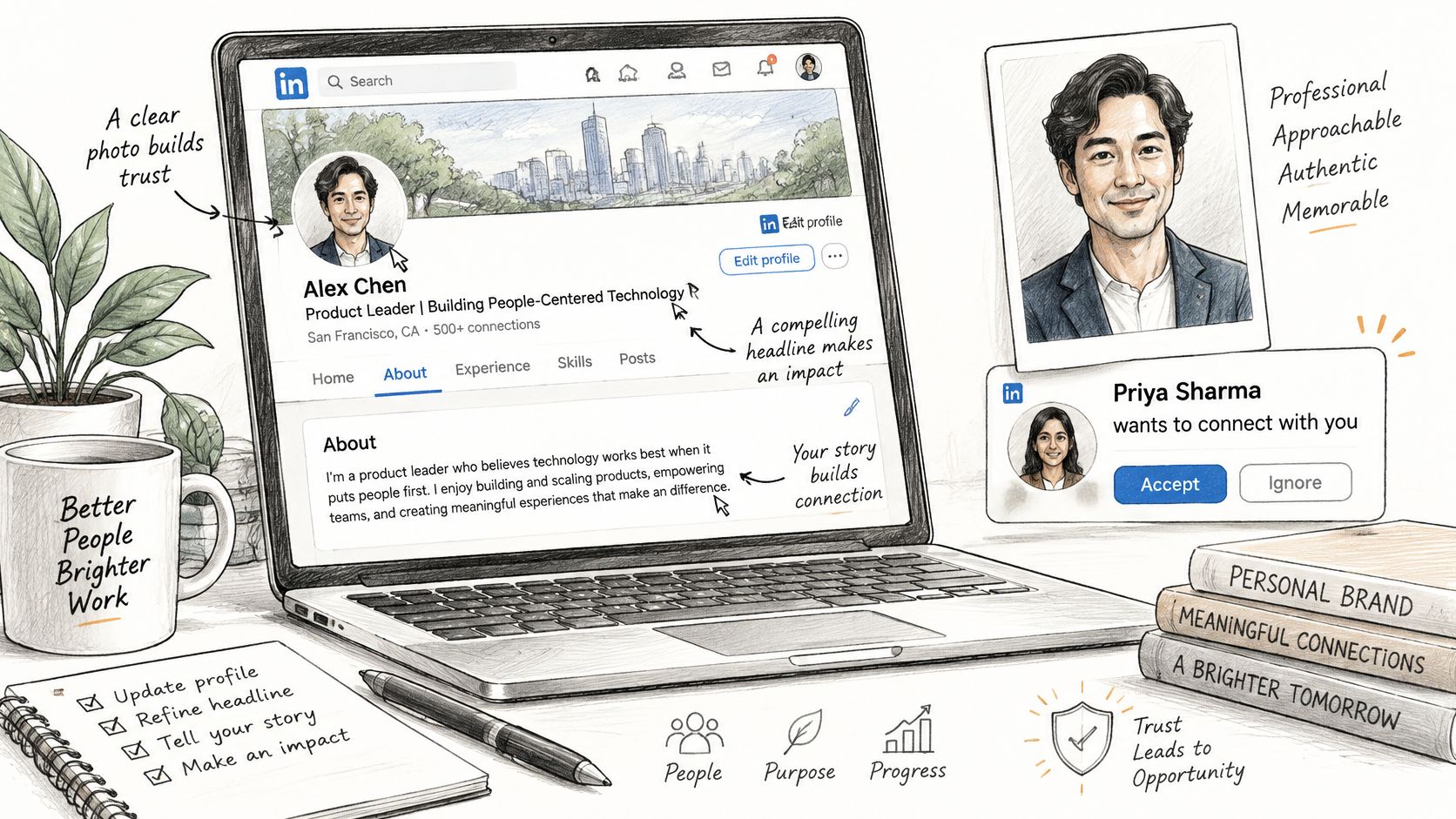
Headline states the outcome for this month's segment, not a stack of services. The About section holds one proof point and stops. Featured content matches the segment you are working, not a graveyard of old launches. A clear face helps that scan. The AiHeadshots LinkedIn photo guide is a practical pass on lighting, crop, and background before you spend a week sending invites from a blurry headshot.
Two touches, then the request
Warm-up stays small. Visit the profile. Wait one or two days. Like or comment on a recent post only when the post is real and relevant to the problem you sell against. Empty praise and liking everything train people to ignore you.
The name is familiar before the invitation, so the request feels less cold. Pair that with a connection request that has no pitch, or a one-line note. A follow-company request belongs only when the company page is active and the person is likely to see it.
A typical three-step scene looks like this. Day one, the profile visit. A day or two later, a like on something they wrote. Then the request, referencing the role or that post, still with no demo ask. Acceptance is usually higher than a request sent cold. Exact rates still move with list quality, offer, and whether a person reviewed the note.
Public benchmark summaries, discussed in an academic review of LinkedIn lead generation, put cold connection acceptance roughly at 20-35% and cold DM response at 5-10%, while warm outreach can reach 50-70% acceptance and 15-25% response. Treat those ranges as directional, not a guarantee.
Warm-up fails when the like is generic. If you would not send that comment to a colleague, do not put it on their post.
Flowkon warm-up actions can schedule the visit and the like inside one campaign so the gap stays consistent. That scheduling does not remove LinkedIn risk, and it does not make the activity approved.
Write Connection Notes and Follow-Ups People Answer
The connection note has a two-sentence ceiling. One sentence points at something specific: their role, a post, or shared context. The second gives a reason to connect. There is no demo ask, no calendar link, and no "quick question" that is really a pitch.
Personalization variables such as first name and company help you scale that line. They fail when the variable is the only human part. {first_name}, I help companies like {company} grow is a mail merge, not a note. Agencies should keep one client-specific proof line in the template so two clients never sound identical.
Free plans can attach a personalized note to only a small number of invites each month. Premium is not capped the same way. Plan blank requests for the rest of a free account, and save notes for the highest-value rows. If you later put sending on a timer, LinkedIn message automation for outreach is worth reading beside LinkedIn's own rules. Automation does not make a bad note safer.
Three notes you can adapt
After their post:
Hi {first_name}, your point on handoffs breaking after the demo matched what we see with teams {company}'s size. I'd like to stay close to that thread.
Tied to role, still no pitch:
Hi {first_name}, I follow how revenue leaders at companies like {company} keep follow-up from dying after an acceptance. Open to connecting.
Blank request:
Use no note when you are out of personalized invites, or when you have nothing specific. A blank request beats a recycled pitch.
Bad, four lines of product:
Hi {first_name}, we built a platform that automates LinkedIn and email, syncs your CRM, and books more meetings. Teams love it. Do you have 15 minutes this week for a demo?
Good, same person:
Hi {first_name}, your post on SDRs losing accepted connections was specific. Connecting so I can see how {company} handles that.
More patterns sit in these LinkedIn cold message examples that get replies. Steal the shape, not someone else's offer.
After they accept
Wait one to two days. The first message asks a problem-oriented question. It does not repeat the pitch.
"Curious how {company} decides who gets a second touch after an acceptance, and who gets dropped."
The later follow-up adds one observation or a useful resource. "Just bumping this" is how replies die. If they answer, stop the sequence the same day.
Run a Weekly LinkedIn Prospecting Schedule Within Safe Limits
Run one campaign all week. Five disconnected blasts create duplicate touches and no memory of who already replied.
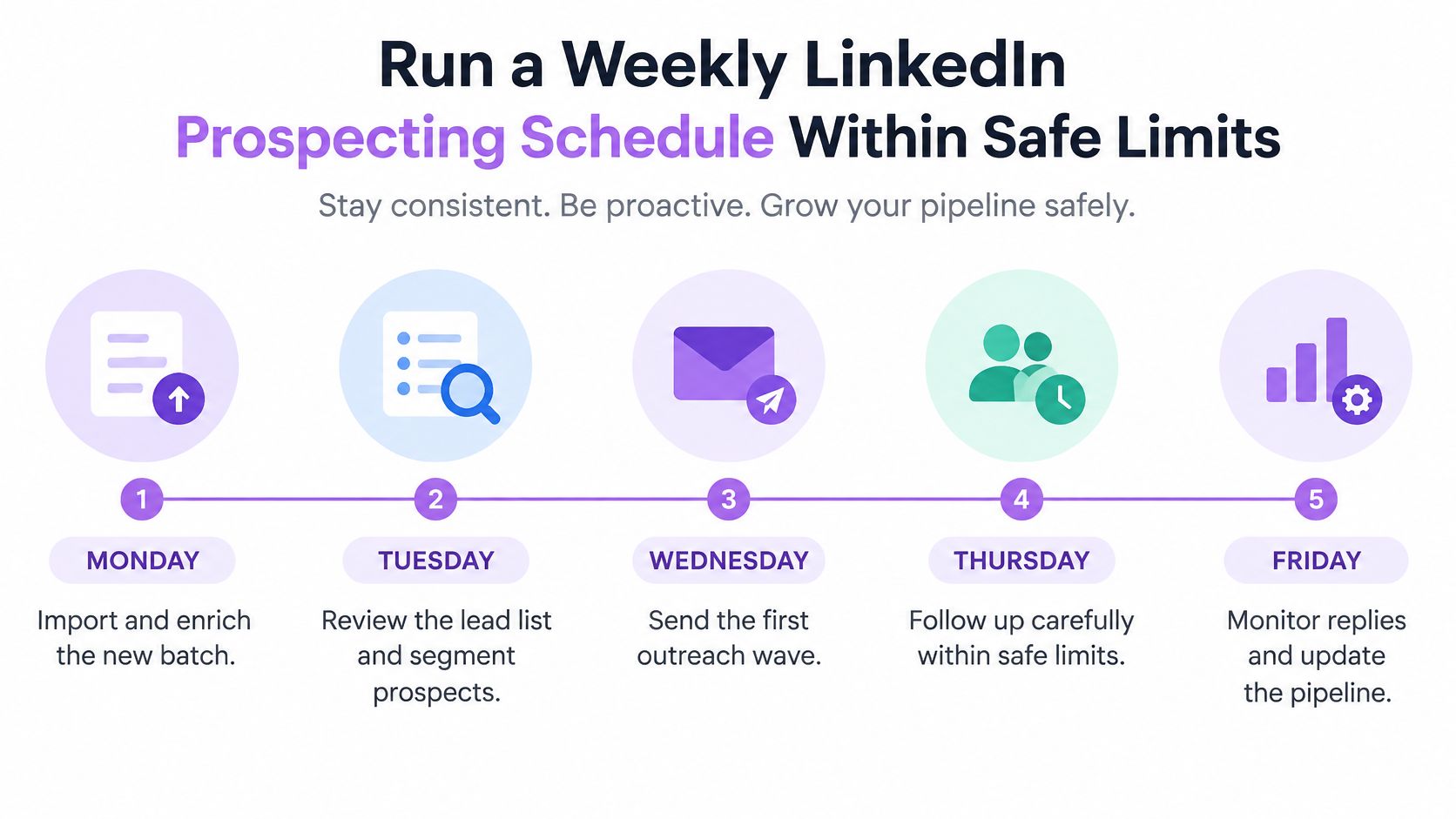
One campaign across five days
- Monday: Import and enrich the new batch, verify emails, and start profile visits plus a relevant like.
- Tuesday: Review segments, then begin connection requests, spread through the day.
- Wednesday: Continue that first wave. Do not dump the rest at 9 a.m.
- Thursday: Message people who accepted, only after the one-to-two-day wait.
- Friday: One follow-up to people who have not replied. If the plan says email is next, stop LinkedIn nudges for that person.
- Every day: Answer replies the same day. A fast human reply beats another automated step.
Adjustable daily limits in Flowkon are a way to cap your own activity. They are not protection from LinkedIn, and they do not make a workflow approved.
What can actually get an account restricted
LinkedIn's help documentation says the company does not allow third-party software or browser extensions that scrape data, modify the site, or automate activity. Using those tools violates the User Agreement and may create privacy-law issues in some jurisdictions. Examples include bots that add contacts, send messages, or generate inauthentic engagement.
LinkedIn does not publish one universal daily invitation number in that guidance. Accounts that reach the invitation limit may be temporarily restricted, typically for one week. Basic and free members can include a personalized note with only five connection requests per month, while Premium members can send unlimited personalized messages with connection requests. Do not confuse "I can invite" with "I can attach a note."
A deeper look at pacing belongs in this safe LinkedIn invite guide. Keep volume conservative, keep a human on review, and do not share accounts. If LinkedIn restricts the account, pause for the restriction period. Do not hop to a second login or a workaround to keep sending.
Branch the Sequence and Add Email Without Repeating the Pitch
The weekly plan is the happy path. The branch is what the prospect did.
If the request is accepted, wait, then send the first message. If it is still pending after five to seven days, stop LinkedIn nudges. Send a follow-company request only when the page is active, or move to a verified email. If they reply at any point, pull them out immediately so a later step cannot fire. Nothing feels more automated than a follow-up after they already answered.
When a verified email exists and LinkedIn stayed quiet, the email should reference the earlier touch. "I sent a note on LinkedIn after your post about onboarding handoffs" is a continuation. A fresh pitch is a second cold start.
Test one variable at a time. Hold the audience, the sender, and the offer still. Change the opening line, the proof, the call to action, the delay, or the email handoff. If you change five things, Friday's numbers cannot tell you which one mattered.
Email is regulated, even in B2B
The FTC's CAN-SPAM guide is explicit: the law makes no exception for B2B messages. Commercial email needs accurate sender and routing information, no deceptive subject line, an advertisement label where required, a valid physical postal address, and a working opt-out. Honor the opt-out across mailboxes. A person who unsubscribes must not re-enter through another campaign or a LinkedIn step that dumps them back into email.
How to wire that handoff is covered in this guide to combining LinkedIn and email in one sequence.
Flowkon's campaign builder is one place those branches can live: triggers and conditions, personalized variables, LinkedIn and email steps in the same campaign, a centralized inbox for replies, and CRM sync to HubSpot, Salesforce, Pipedrive, Zoho, or Monday. The tool records what happened. It does not make the copy relevant, and it does not override LinkedIn's rules or CAN-SPAM.
Measure Meetings and Fix the LinkedIn Lead Generation Strategy
Review a cohort, not a vanity total. Invitations sent, accepted, replied, positive reply, meeting booked. A public benchmark set, summarized by Traxy, analyzed more than 13.2 million connection requests across 13,302 accounts and reported a 28.5% average acceptance rate, 3.0% reply to connection notes, and 10.4% reply to post-connection messages. Averages hide sector, seniority, and offer. Use them to plan, not to grade yourself.
In campaigns built with a warm-up and a no-pitch note, acceptance has landed around 40% for us. List quality moves that number. A figure of 80%+ on a very tight list is not a promise, and it is a bad target for a broad search.
What each LinkedIn rate is telling you
StageDirectional rangeIf this stage is weakAcceptance28.5% average in that large datasetList fit or the profile is offReply to the connection note3.0% in the same datasetThe note is a pitch, or it is genericReply after connecting10.4% in the same datasetThe first message is the problemMeeting bookedNo universal public rateThe ask is early, vague, or aimed at the wrong role
Read one stage, then change one thing. Weak acceptance means tighten the list or the profile. A dead note means cut the pitch. A dead first message means rewrite the question. Meetings that never appear mean the ask, not the volume.
The mistakes that inflate activity and shrink pipeline are familiar. Chasing connection volume over ICP fit. Changing five variables in one week. Pitching inside the request. Letting a sequence keep talking after a human replied. Counting every reply, including "not interested," as pipeline.
Build one segment, one warm-up, and one branch. Review that cohort next Friday and change a single line of copy. That is a LinkedIn lead generation strategy you can run again, instead of another pile of unanswered invites.
Flowkon runs the weekly sequence in one place: warm-up actions, connection requests, conditional LinkedIn and email steps, a shared inbox, and daily activity caps you set yourself. If you want that operating rhythm for a defined account list, start a free trial at Flowkon.