.webp)

Most LinkedIn cold messages fail because they ask for too much before earning attention.
The ones that get replies are simpler. They feel relevant, give the prospect a reason to care, and make the next step easy. In a large 2026 benchmark, 28.5% of connection requests were accepted, but only 3.0% of connection notes got a response, and 10.4% of outbound LinkedIn messages got a reply.
That tells you something important. Each touch has a different job. A connection request earns attention. A follow-up starts a conversation. InMail has to justify why this person should open and answer.
The rule is straightforward: one credible reason to reach out, one clear message goal, and one low-friction next step.
The seven examples below show how to do that across connection requests, follow-ups, and InMail. Use names, referrals, metrics, deadlines, and resources only when they are truthful and verifiable. Before writing, identify the stage, choose the single job, pick one defensible personalization detail, and decide what the prospect should do next. A large 2026 benchmark found that the H1 dataset produced nearly the same outcomes, with 29.61% acceptance and 10.3% message reply, reinforcing that the connection request, note, and post-connection message behave differently rather than forming one uniform funnel.
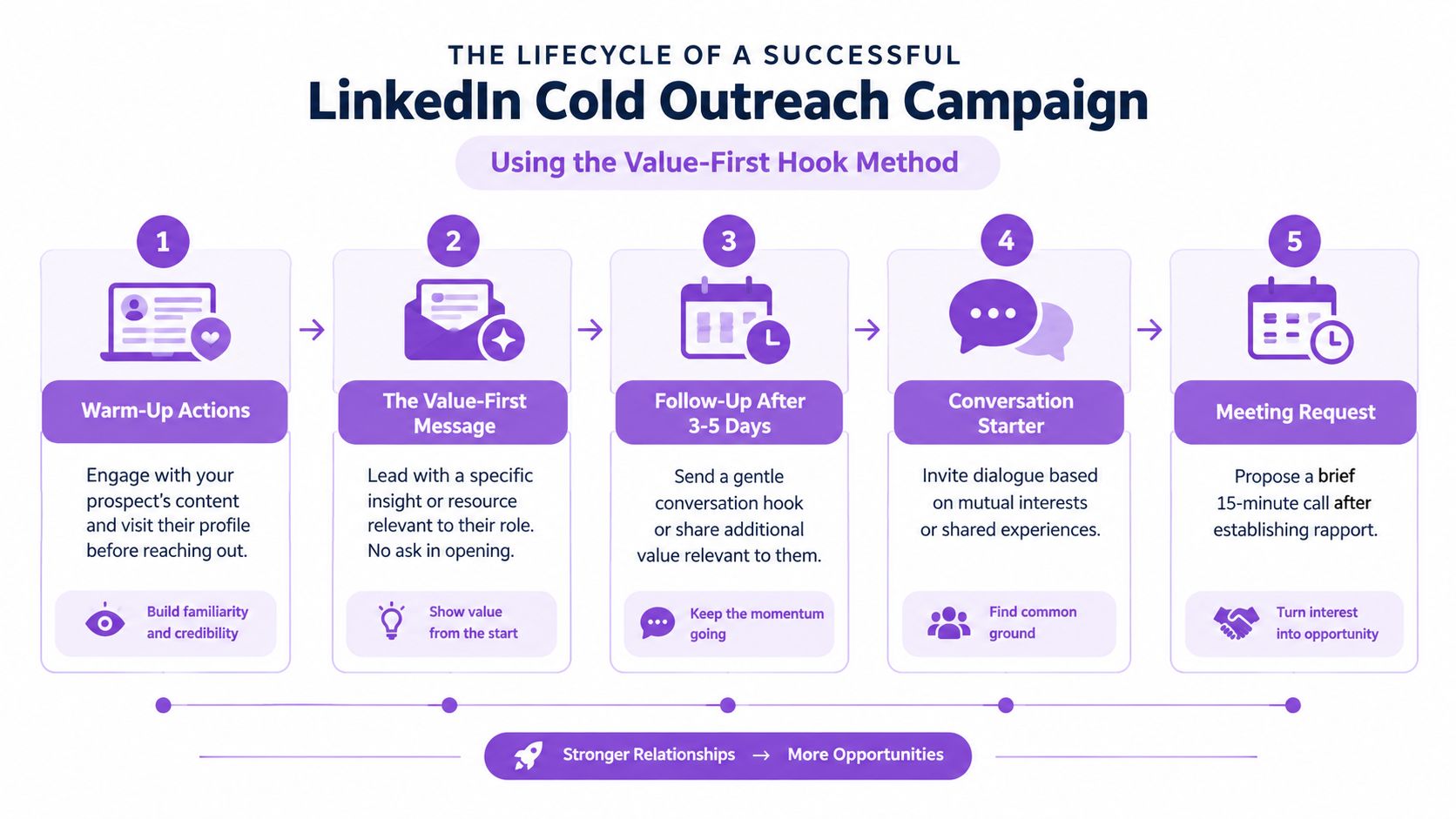
1. Start with an Opening Hook That Delivers Value
The opening hook gives the prospect a useful reason to engage before asking for time. It works best as a connection request or first touch because it changes the interaction from “listen to my pitch” to “this might be relevant to your work.”
A good opening starts with an observable trigger, not a broad compliment.
Practical rule: If the resource would be useless without your product in the background, it probably isn't value. It's a disguised pitch.
Try:
Saw you recently moved into VP Sales at [Company]. Since your team is growing, I thought this short guide to ramping new reps might help. Happy to connect.
Or:
Your post on [topic] made a strong point about [specific detail]. I work with teams facing the same issue and found a benchmark that adds another angle. Thought you might find it useful.
The first sentence should contain the reason for contact. Use a recent role change, company milestone, published post, hiring pattern, or relevant market development. Don't force personalization from a profile detail that has nothing to do with your offer.
The best resource might be a short benchmark, a relevant article, a useful checklist, or an observation about the prospect's market. It doesn't need to be your own asset. A useful third-party resource can create more trust than a branded PDF designed to lead directly to a demo.
When to use it
Use this approach when the prospect has a visible trigger, and you can offer something specific without requiring a meeting. Follow up after three to five days with a conversation hook, not the same link again:
Did the point about [specific issue] line up with what you're seeing at [Company]? Curious how you're handling it.
Research recent activity manually or with a structured workflow. Personalized outreach workflows can help teams keep the trigger, message, and follow-up connected, but the judgment about whether the resource is relevant still belongs with the sender.
2. The Social Proof Pattern
Social proof earns attention by reducing uncertainty, provided the connection matches the prospect's situation. A verified mutual contact, relevant customer, shared project, or comparable peer can establish credibility. It cannot rescue weak targeting or an unrelated offer.
Choose one proof point and tie it to one operational issue:
[Mutual Contact] suggested I reach out. She mentioned you're leading [initiative] at [Company]. We've helped similar teams improve [specific process]. Would it help to compare notes?
A customer example can work in a connection request, follow-up, or InMail:
We recently worked with [Known Company] on [specific challenge]. Your team seems to be navigating a similar shift. Happy to share what changed if it's useful.
Use the customer's name only with permission. Confirm that a mutual contact knows the prospect and is comfortable being mentioned. Shared membership in a LinkedIn network is not an introduction.
The strongest proof names a relevant change in plain language, such as less manual work, cleaner handoffs, or clearer reporting. Avoid listing several logos or claims. One accurate connection gives the reader a reason to continue, a stack of vague signals creates more doubt.
The decision rule
Use social proof in a connection request when the relationship is real and directly relevant. Use it in a follow-up when the connection is credible but too weak to lead with. In InMail, pair the proof with a specific reason the prospect's role or initiative resembles the example. If all you can say is “we work with companies in your industry,” lead with a well-supported observation about the prospect instead.
For a verified example of this approach in practice, see how Callbox Inc. boosted reply rates by 200% using Flowkon without raising client costs. Check whether the customer, problem, and outcome are close enough to your audience before borrowing the format.
A recruiting benchmark covering more than 4,000,000 messages across more than 1,500 recruiting organizations reported a 17.08% average LinkedIn reply rate, compared with 4.96% for cold email. Among more than 165,000 candidates contacted on both channels, LinkedIn generated 3.8 times as many replies, and 78% of responders replied only on LinkedIn. (The recruiting outreach benchmark report) Use those findings as context for testing LinkedIn's professional setting, not as a promise for every campaign.
Test the proof source, level of detail, and call to action separately. If there is no response, replace the proof before increasing follow-up volume.

3. The Problem Impact Solution Framework
Problem-focused messaging works when the sender has enough understanding to describe a problem without pretending to know the prospect's internal situation. The structure is compact: identify a likely problem, name its consequence, and hint at a way to address it.
For example:
Sales leaders often lose pipeline visibility when deals move across too many stages. Reps spend time chasing deals that should be closed out, and forecasts get harder to trust. We've helped teams tighten that process. Is that something you're working through?
The framing should create recognition, not fear. Name the operational consequence, such as wasted rep time, inconsistent delays, slow hiring, or unreliable forecasting. Don't claim a dollar cost or performance impact unless you have evidence for that specific prospect or an approved customer story.
A weaker version says:
I help businesses improve sales performance. Open to a call?
That message describes your service, not the prospect's problem. It gives the reader no reason to believe the conversation will be relevant.
How to make the problem credible
Use a problem that is specific enough to feel researched but broad enough to be relevant for the segment. A VP of Sales at a fast-growing company may recognize inconsistent qualification. A RevOps leader may recognize data scattered across systems. An agency owner may recognize the difficulty of maintaining personalized follow-up across client accounts.
Test the problem statement internally before sending it. If experienced sellers in the same market don't recognize it, the prospect probably won't either.
Keep the solution deliberately brief:
One pattern I'm seeing is that teams add more activity before fixing the handoff between marketing and sales. We've been helping them make that process easier to inspect. Is that relevant for you?
The right next step is usually a question, not a calendar link. Once the prospect confirms the problem, you've earned the right to explain the approach or suggest a conversation.
4. The Curiosity Gap Open Loop
Curiosity can earn a response when it points to something real and relevant. It fails when the sender withholds information only to manufacture suspense.
Try:
I noticed a pattern in how competitors are positioning [product category]. It may affect how [Company] talks about [specific offer]. Want me to send the three takeaways?
Or:
Saw your move into [role]. Three things stood out about the first phase of your team's growth. One may be useful for your priorities. Want me to send them here?
The open loop gives the prospect a reason to respond without forcing a meeting. It's particularly useful for a follow-up after a profile visit, content interaction, company announcement, or role change.
Deliver what you promise
The follow-up must contain the value you teased. If you offer three observations, send three concise observations. If you mention competitor positioning, explain the specific difference you saw. Don't replace the promised insight with a booking link.
A credible follow-up might look like this:
The three points were: competitors are narrowing their category language, leading with implementation speed, and using customer proof earlier in the buying journey. Curious if any of those match what you're seeing.
That message invites a professional exchange. It doesn't pretend the observation is a secret or imply that the sender has privileged information.
Use this approach sparingly in a sequence. Curiosity works better when it reflects a real observation than when every message says “I noticed something.” Test it by segment. A SaaS buyer may respond to a positioning pattern, while a recruiter may care more about a candidate-market signal or a specific hiring trend.
A curiosity gap is only as strong as the information waiting behind it.
The next-step workflow is simple. Identify the observable pattern, write the shortest honest teaser, choose a soft response option, and prepare the full answer before sending. If you can't explain the insight in the next message, don't use the open loop.

5. The Specific Ask Clear CTA
The specific-ask message removes ambiguity. It tells the prospect exactly what you want and makes the action small enough to consider.
Use a question that can be answered quickly:
Quick question. Is your bigger bottleneck hiring qualified SDRs or getting consistent follow-up from the current team? Reply A or B.
Or:
What's the main challenge in your pipeline right now? One sentence is enough.
A short call can work when the context is strong:
I'd like to compare notes on your pipeline process and share what similar teams are changing. Would 15 minutes next week be useful? Here's my calendar: [link].
The specific ask succeeds because the prospect doesn't have to decode your intention. It also gives you a clean way to assess whether the offer is appropriate. If a direct question gets no response, adding more product detail usually won't fix the issue.
Make the Next Step Feel Natural
A connection request should usually ask for connection, not a sales call. A first follow-up can ask for a one-sentence answer, a reaction to a resource, or permission to share an idea. InMail can support a more explicit request when the relevance is unusually strong.
Keep the promised effort accurate. If you say “two-minute video,” make it two minutes. If you offer a brief call, explain what the prospect will get from it. Avoid “Do you have time to chat?” because it leaves the purpose and commitment unclear.
A useful test is to remove everything except the ask and the reason:
Are you focused more on [A] or [B] this quarter? I'm asking because [specific observation about their role or company].
If the message still makes sense, the CTA is probably clear. If it doesn't, the message may be relying on a generic offer.
For teams that need to coordinate LinkedIn and email without repeating the same pitch, this LinkedIn and email outreach sequence guide provides a useful channel decision framework. The principle is straightforward: use each channel to add context, not to duplicate pressure.
6. The Referral Permission-Based Hook
A referral or permission-based hook works because it explains why the outreach is happening now. It can come from a genuine introduction, an event, a resource request, a prior conversation, or another real engagement signal.
Try:
[Name] from [Company] suggested I reach out. She mentioned you're leading [initiative] and thought our work on [specific problem] might be relevant. Would a brief conversation help?
An engagement-based version might say:
You attended the session on [topic]. A few attendees asked about [specific issue], so I pulled together a short follow-up with practical steps. Want me to send it?
The wording must reflect what happened. A profile view isn't permission to imply a conversation. A content download isn't proof that the prospect is evaluating your product. Accurate context protects trust and gives the recipient a fair basis for deciding whether to respond.
Verify the source before scaling
If a colleague or customer made the referral, confirm the exact wording and the reason for the introduction. If the prospect attended an event, check the registration or attendance record. If they downloaded a resource, make sure the activity is legitimate and that your outreach complies with your organization's privacy and contact policies.
The decision rule is clear: use the hook only when you can name the source and explain the connection naturally. Otherwise, use a value-first or problem-led approach.
A referral message also needs a next step:
If that's on your agenda, I can share the short version here first. If not, no problem.
That permission lowers pressure without weakening the purpose. It tells the prospect they can decline, which often makes the message feel more respectful than a forced assumption of interest.
For larger teams, maintain a record of who introduced whom, what engagement occurred, and whether the person agreed to further contact. A clean handoff is more valuable than a clever sentence.
7. The Timing-Based Follow-Up
Urgency should describe a real constraint, not manufacture one. A genuine deadline might involve a fixed event date, limited workshop availability, a program cohort, an implementation window, or a documented offer end date.
For example:
I'm holding office hours next Tuesday for revenue leaders working through pipeline visibility. I have a few open slots. Would one be useful for you?
Or:
We're planning the next onboarding group for [month]. If improving [specific process] is already on your roadmap, happy to compare timing before the group is finalized.
The message works because the constraint is tangible. “Only three spots left” means little if the sender can create more spots instantly. “This expires today” loses credibility when the same offer appears in every later message.
Introduce pressure gradually
Don't lead with scarcity when there's no prior relevance. Start with the problem or value, then mention the deadline once the prospect understands why it matters:
You mentioned that [problem] is a priority. We're finalizing the schedule for the next implementation window, so I wanted to check whether timing is relevant. If it is, would Thursday or Friday work for a short discussion?
This approach keeps urgency subordinate to usefulness. It also gives the prospect a clear choice rather than forcing a decision under artificial pressure.
Sending behavior matters here. A 2026 outreach playbook recommends keeping LinkedIn connection requests around 15 to 25 per day and using warm-up actions, message variation, and multichannel escalation when LinkedIn goes quiet.
LinkedIn states that reaching an invitation limit may temporarily restrict an account from sending invitations, with the restriction typically lasting one week. That makes governance part of the urgency strategy. A deadline-driven campaign isn't useful if aggressive sending creates an avoidable operational problem.
7 LinkedIn Cold Message Strategies Compared
| Tactic | Implementation Complexity | Resource Requirements | Expected Outcomes | Ideal Use Cases | Key Advantages |
|---|---|---|---|---|---|
| The Value-First Hook | Medium, requires targeted research and curated assets | Moderate, time to research 5-10 data points or find relevant resources | Higher opens/engagement and stronger credibility before pitching | Outreach to decision-makers, high-touch accounts, second-message strategies | Differentiates sender; builds trust without asking up front |
| The Social Proof Pattern | Low-Medium, verify mutuals or customers before use | Low, maintained customer/partner list and CRM checks | Significantly higher open and response rates; easy verification | B2B enterprise, tight communities, warm or semi-warm prospects | Reduces spam perception; leverages network trust |
| Problem-Agitation-Brief Solution | Medium, needs accurate problem selection and concise agitate | Moderate, subject-matter knowledge and customer outcomes | Strong reply quality; attracts prospects who recognize the problem | Mid-market/enterprise outreach where relevance must be quick | Consultative tone; creates urgency and curiosity without heavy pitching |
| Curiosity Gap / Open Loop | Low, short teasers but requires disciplined follow-up | Low, creative copy + prepared follow-ups | High click-through and replies but can attract low-intent responders | First-touch outreach to drive profile visits and initial engagement | Drives attention and clicks; works well on mobile/short attention spans |
| Specific Ask / Clear CTA | Low, straightforward single ask, minimal copy | Low, scheduling links or short assets; measurable tracking | High completion for low-friction asks; easy to measure engagement | Follow-ups, mid-funnel, and campaigns seeking small commitments | Removes friction; clear, measurable next step |
| Referral / Permission-Based Hook | Low-Medium, must confirm referral/permission authenticity | Moderate, tracking engagement signals, referral data hygiene | Very high acceptance/response rates when referral is real | Warm outreach, referral campaigns, follow-ups after downloads/events | Built-in trust and permission; lower defensive reactions |
| Deadline / Scarcity Play | Low, simple to state but must be genuine and verifiable | Low-Moderate, real constraints (slots, cohorts, offer end dates) | Higher response and quicker decisions; can self-qualify prospects | Re-engagement, limited-time offers, scheduling constrained slots | Creates urgency and motivates action when scarcity is real |
Turn the Best Example Into a Tested Sequence
Don't choose a message because it sounds clever. Choose it because it matches the job the next touch needs to perform.
If you need to earn a connection, start with the value-first hook or a relevant observation. If you need to open a conversation after acceptance, use a problem-led question or a specific ask. If you have a verified mutual contact, referral, or engagement signal, use the permission-based approach. Save urgency for a real time constraint and use curiosity only when you can deliver the promised insight immediately afterward.
Define the smallest credible personalization detail. That might be a recent role change, a specific post, a company announcement, a hiring initiative, or a problem that clearly fits the person's responsibilities. One accurate detail is better than five generic tokens inserted into a template.
Adapt the wording to the channel. A connection request needs a reason to connect. A follow-up should build on the accepted connection or previous message. InMail needs a stronger explanation of why you selected that person and why the subject deserves attention. LinkedIn's own help center defines InMail response rate as responses received within the first 30 days after sending, excludes messages sent to email addresses, and includes free InMail to direct connections and Open Profile members as well as bulk InMail.
Test one variable at a time:
Opening observation: Compare a role change with a company or market trigger.
Problem framing: Test operational friction against a consequence the prospect already recognizes.
Proof point: Compare a verified customer example with a mutual connection.
CTA: Compare a one-sentence question with a short call request.
Separate connection acceptance, reply, qualified conversation, and meeting outcomes. A reply isn't automatically a qualified opportunity, and a meeting isn't proof that the original message created durable interest. A separate benchmark of 180,155 LinkedIn connection requests found 27.1% acceptance, 27.6% of accepted connections producing a reply, and 2.0% of accepted connections producing a booked meeting. (Reachium's 2026 LinkedIn outreach research) The funnel narrows at each step, so your reporting should show where it narrows.
Before sending, check:
Accurate trigger: Does the opening detail reflect something real?
Truthful proof: Can you verify every name, result, referral, and resource?
One idea: Is the message built around one problem or observation?
One ask: Can the prospect understand the next action immediately?
Natural wording: Would a real seller say this in a professional conversation?
No invented urgency: Is the deadline or limited availability genuine?
Teams that need to coordinate LinkedIn and email sequences, manage replies in one inbox, personalize templates, sync activity with a CRM, and review campaign analytics can use Flowkon as part of that workflow. It can help organize the execution, but it won't replace accurate targeting, honest personalization, or judgment about when to stop.
LinkedIn cold messaging works best when each touch earns the next one. Pick one message job, write the smallest credible version, measure the stage that matters, and improve the weak point instead of adding more volume.
Flowkon helps B2B teams build LinkedIn and email outreach sequences, manage conversations in a centralized inbox, personalize messages, and sync campaign activity with CRM systems. Visit Flowkon to see how the workflow can support more structured LinkedIn cold messaging.





.svg)

