
Marketing has a list of downloads. Sales has a list of accounts. Neither team has enough qualified meetings, and both think the other should fix it. The useful distinction in lead generation vs prospecting is simple: lead generation helps buyers discover you and identify themselves; prospecting starts a relevant conversation with people you've chosen to approach.
The harder question is when to hand someone from discovery to a sales conversation without interrupting an evaluation they'd rather handle themselves.
Lead Generation vs Prospecting at a Glance
Lead generation creates and captures identifiable demand through search, content, events, referrals, advertising and forms. Prospecting starts direct contact with suitable accounts or people, including those who haven't asked to speak with sales.
| Criterion | Lead generation | Prospecting |
|---|---|---|
| Core goal | Create and capture identifiable demand | Start direct contact with suitable accounts or people |
| Who starts the contact | The buyer, through search, content, events, referrals or forms | The seller, through outreach |
| Typical channels | Search, content, events, referrals, advertising and forms | LinkedIn and email sequences, plus referrals from target lists |
| Basis for targeting | Anyone who shows interest | Named accounts and personas chosen in advance |
| Typical output | Identifiable leads with a source and an interest signal | Conversations, meetings and opportunities |
| Usual owner | Marketing, with sales input | Sales development or account teams |
The familiar labels inbound and outbound hide part of the difference. An advertisement is seller-funded distribution, but the buyer still chooses whether to respond. An SDR can approach someone who already reads your content, so seller-initiated contact doesn't necessarily mean the relationship is cold. Ask who makes the first move and how much the buyer already knows, not just which channel appears in the CRM.
Different work, different constraints
Lead generation requires useful information and a credible reason to share contact details. A page that attracts the wrong audience can produce plenty of forms without helping sales. For teams reviewing that acquisition work, the growth marketing guidance from Scéaled provides a useful companion to the sales-side decisions.
Prospecting requires selectivity. A clean target list isn't enough if the rep can't explain why the recipient should care now. Personalizing a greeting doesn't compensate for an irrelevant offer.
Practical rule: A lead is evidence of interest. A prospecting decision is a judgement about whether direct contact could be useful.
Check your current team against the table. If marketing produces identifiable interest but sales receives no context, fix the handoff. If SDRs have clear account criteria but no useful content to share, strengthen the material that supports their conversations before increasing activity.
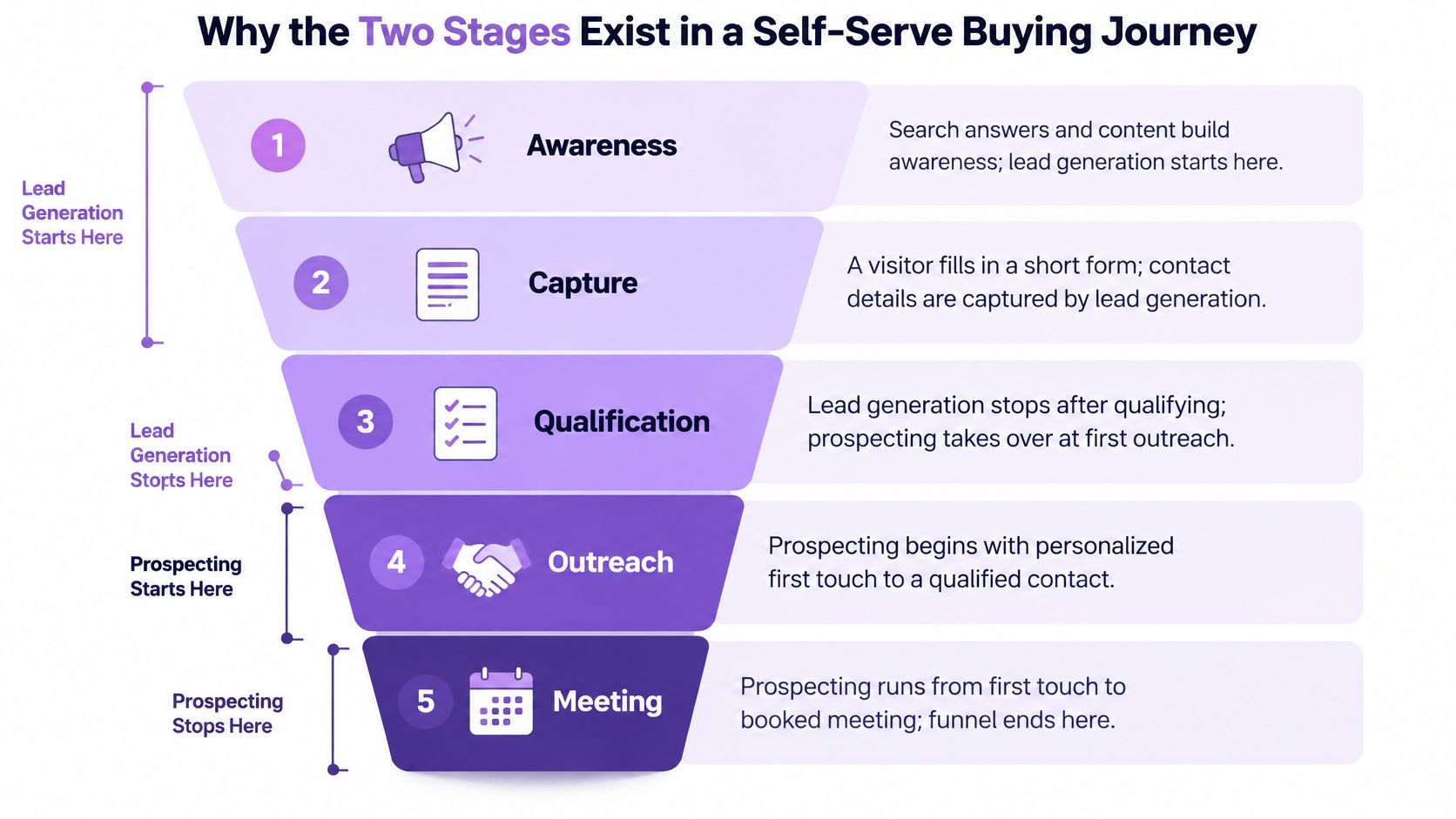
Why the Two Stages Exist in a Self-Serve Buying Journey
Buyers don't need a representative to explain every basic feature. An industry summary citing Forrester, published by Statistics Fundamentals, reports that approximately 70% of the B2B buying journey is completed before a prospect first contacts a vendor.
Preferences form early, too. Reach Marketing's roundup of B2B lead generation research summarizes buyer studies finding that buying groups frequently rank preferred vendors before their first sales conversation, and often purchase from the vendor they favored at the start. The practical consequence: when a rep finally speaks to an inbound lead, the shortlist may already exist.
Discovery and validation need different support
A Gartner survey of 645 B2B buyers found that 69% wanted sales representatives to validate AI-generated insights, even though most of their research happens without a rep in the room. Those preferences aren't contradictory: someone can research independently and still want help deciding whether a solution fits their circumstances.
Treat the funnel as an operating model, not a rule every buyer follows:
Awareness. Publish answers to problems buyers can recognize before they know your product. Lead generation starts with making those answers discoverable.
Capture. A visitor submits a form or otherwise becomes identifiable. An anonymous visit alone isn't a named lead.
Qualification. Check company fit, role, problem relevance and evidence of timing. Record budget and authority as unknown when they haven't been established.
Outreach. A rep offers a question, observation or resource that advances the buyer's evaluation.
Meeting. The rep confirms a reason to talk and passes the context into the sales conversation. A booked meeting still isn't automatically an opportunity.
In the inbound workflow, qualification is the handoff between capture and direct sales work. Outbound prospecting can begin without a captured lead at all, using a researched account hypothesis instead.
The underlying distinction is discovery versus validation. Search results, comparisons and customer evidence let buyers investigate on their own. A sales conversation earns its place by answering the contextual question those materials couldn't resolve: does this fit our environment, our constraints, our timeline?
The handoff fails in both directions. A downloaded guide doesn't establish purchase authority or an approved project, so routing every form fill straight to an SDR floods reps with unqualified names. The opposite failure is quieter and more expensive: treating every identifiable visitor as a prospecting target. A buyer who downloads one guide and receives an aggressive automated sequence learns to stop filling out forms, and the future demand your lead generation depends on disappears with them.
How Each Motion Runs From First Touch to Meeting
A demo request sitting unanswered for three days while an SDR works a cold list is the classic symptom of tangled workflows. Build each motion separately, then define the routing between them: lead generation handles discovery, prospecting handles validation, and the handoff between them is where pipelines leak.
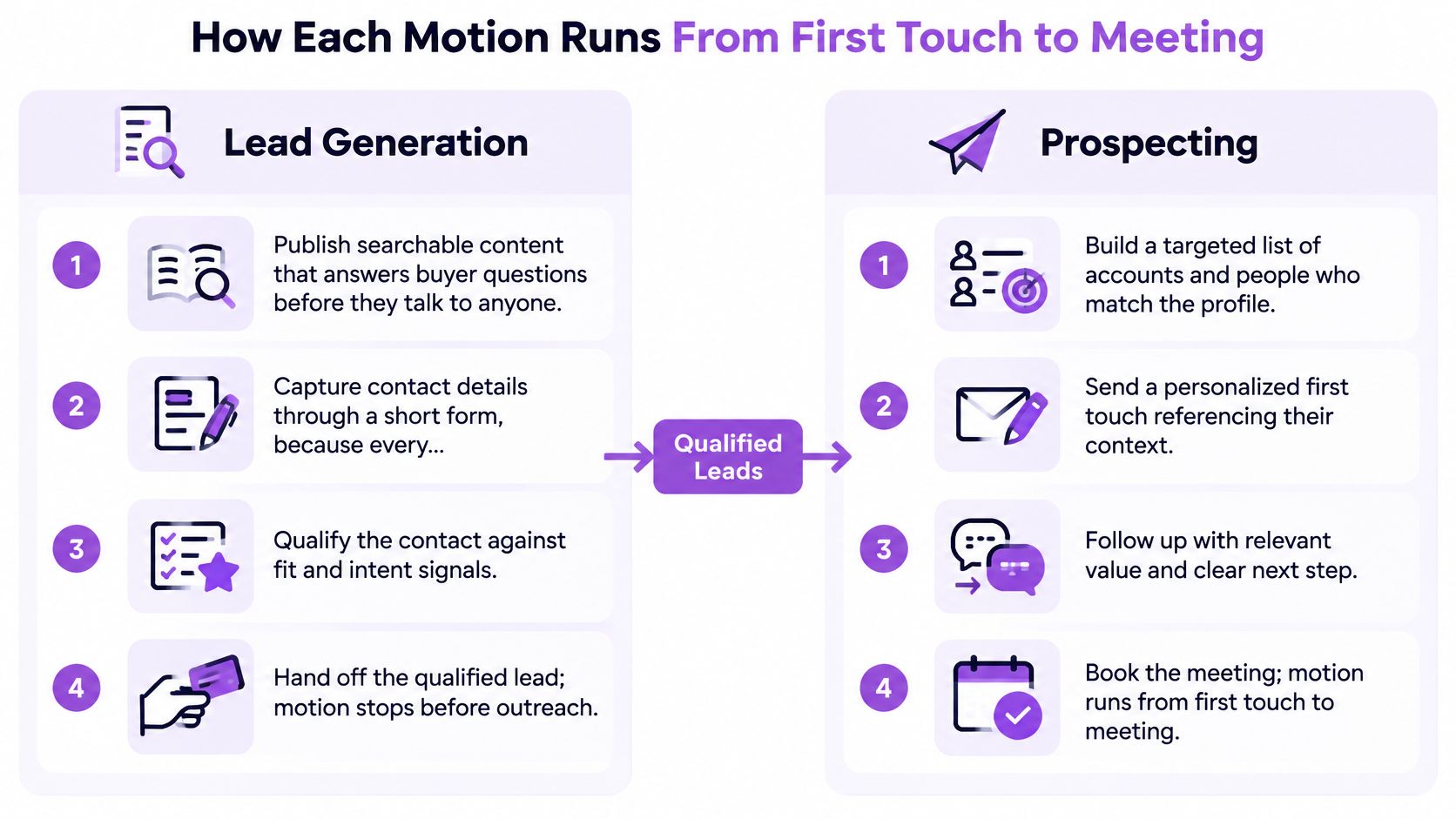
The lead-generation workflow
Publish searchable answers. Cover implementation, alternatives, costs and the operational problem itself. Keep the basic explanation ungated; locking away the content a buyer needs just to understand your offer filters out exactly the people still deciding whether the problem is worth solving.
Capture only what routing needs. A short form asking for the details required to deliver the resource and make the next decision is enough. Enrichment tools can fill in verified company and role data afterward, before anyone reaches out.
Qualify fit and intent separately. A suitable company and an active project are two different findings. Preserve both in your routing logic, because a single blended score hides which of the two is missing.
Assign an owner and a response deadline. A demo request and an educational download deserve different service standards. Write those standards down so a hot request never waits behind a newsletter signup.
Common slip: asking for a full discovery-call questionnaire before delivering a simple resource. Remove every field that nobody uses to make a routing decision.
The prospecting workflow
Build the target list. Prospects can come from LinkedIn, Sales Navigator, event attendees, your own network or CSV uploads. Pair account fit with a relevant trigger, such as a new leader or a hiring spike, to form a genuine reason for contact.
Verify contact data before enrollment. Find and confirm a business email, then check the suppression list. Skipping this step is how domains get burned on the first campaign.
Write a contextual first touch. Name the observation, explain the problem it might create, and ask a question the recipient can answer. Connection requests, follow-ups and emails work best planned together as one campaign any rep can run.
Space follow-ups across several days. Each touch should add a new angle, never a louder repeat of the pitch.
Stop on a reply or opt-out. The conversation moves to a person immediately; a scheduled message should never follow a live reply.
Hand the meeting over with context. The account executive gets the original trigger, the reply history, known constraints and the agreed purpose of the call.
For SDR onboarding, SignalSpot's explanation of what outbound prospecting means helps distinguish deliberate account selection from bulk list sending. Agencies running multi-client outreach can adapt the same motion using this practical outbound playbook for agency lead generation.
Common slip: opening with product capabilities instead of the prospect's problem. In Flowkon, you set the delays between sequence steps yourself, and prospects who reply exit the sequence automatically.
Use this routing rule: fit plus clear intent goes directly to sales; fit without expressed intent may enter a carefully selected prospecting sequence; no fit goes to low-touch nurture or disqualification. Don't spend nurture resources on accounts you can never serve.
Selection discipline matters more than volume here. Every irrelevant cold touch trains a future buyer to ignore you before lead generation ever gets its chance.
Sample Outreach Messages and Follow-Up Sequence
Say you sell order-management software and have confirmed that a target company has opened new locations. The following is an illustrative sequence, not a universal cadence. Use the customer-reference line only if you have a real example you're allowed to share.
First-touch email to an operations director
Subject: [Company] and [specific process]
Hi [First name],
[Company] recently opened [number] sites, and teams in that position often find order data spread across several systems before the first month ends.
If that is on your list, I can share how one team handled it.
Worth 15 minutes next week?
[Your name]
The opening needs a verified observation. If you can't substantiate the operational claim for that audience, replace it with a question about how the company manages the process.
Manual LinkedIn connection note
Send this manually when the person has published something relevant:
Hi [First name], your post on [topic] matched a problem we see in [role] teams. I would like to connect.
Don't claim to have read a post you haven't read. A connection request also doesn't require an immediate sales pitch after acceptance.
Follow-up and closing messages
For an illustrative day-four follow-up, introduce something concrete:
A different angle: [one specific observation]. If it is not a priority, tell me and I will stop.
For an illustrative day-nine closing message, make the end clear:
I will close this thread unless you want the summary. Reply yes or no.
Use the closing message only when there's an actual summary to send. Silence after it means stop, not restart the same sequence under another campaign name.
Keep these writing controls:
Add substance. Each follow-up needs a new fact, question or useful resource.
Remove repetition. Don't rewrite the original pitch with a different greeting.
Respect responses. Stop scheduled outreach on any reply or opt-out.
Check the opening aloud. Read the first line to a colleague; if it could describe any company, rewrite it.
For other buying situations, adapt these sales email templates for each stage of B2B outreach. Add the required sender, advertising and unsubscribe information before sending commercial email.
Metrics That Show Each Motion Is Working
One blended conversion rate hides different operational problems. A form can underperform because the offer is weak, while a prospecting campaign can underperform because the selected accounts have no reason to act.
University of Manchester research on estimating B2B buying stages reports that buyers complete more than half of the purchasing process through digital touchpoints before significant seller contact. Its work also examines how online behavior can help estimate buying-stage progression.
| Motion | Metric | What it tells you |
|---|---|---|
| Lead generation | Visitor-to-lead conversion | Whether content and pages attract visitors who become identifiable |
| Lead generation | Qualified-lead rate | The share of leads that pass a fit and intent check |
| Lead generation | Lead-to-opportunity velocity | How quickly leads move to a real sales opportunity |
| Prospecting | Account coverage and valid-contact rate | Whether the target list is reached with verified contacts |
| Prospecting | Positive-reply rate and meetings booked | Whether outreach starts real conversations |
| Prospecting | Unsubscribe and complaint rate | An early warning that messages are irrelevant or unwanted |
Separate activity from progress
Define each denominator before comparing campaigns. For positive-reply rate, use unique delivered contacts and classify replies consistently. A request to unsubscribe isn't positive engagement, and an automated absence message isn't a conversation.
For meetings, distinguish booked, held and qualified. An SDR can schedule a call without establishing a relevant business problem; counting that call as pipeline encourages poor qualification.
Sequence reporting also needs two views: reply rate by step and cumulative unique reply rate. In sales-sequence benchmarks reported by Belkins, follow-ups collectively produced 58.6% of all replies. That supports evaluating the whole sequence, not declaring success or failure from its opening message.
Count people who replied, not just reply events. Otherwise, a long conversation can make a weak campaign look productive.
Test without changing everything
Hold the audience and offer constant, then change one variable: first-touch channel, personalization approach or follow-up timing. Compare outcomes per delivered contact and per target account so a longer sequence doesn't look better merely because it sends more messages.
Record assisted touches and account-level engagement alongside the final conversion. Someone may read an implementation page, attend an event and then respond to an SDR; the final reply shouldn't erase the earlier work.
Your CRM records should preserve source, campaign, touch sequence and funnel stage, plus the owner and qualification outcome. Use those fields to compare opportunity creation and pipeline efficiency. Contact counts are useful for workload planning, not proof that either motion is working.
Where Prospecting Carries Risk That Lead Generation Does Not
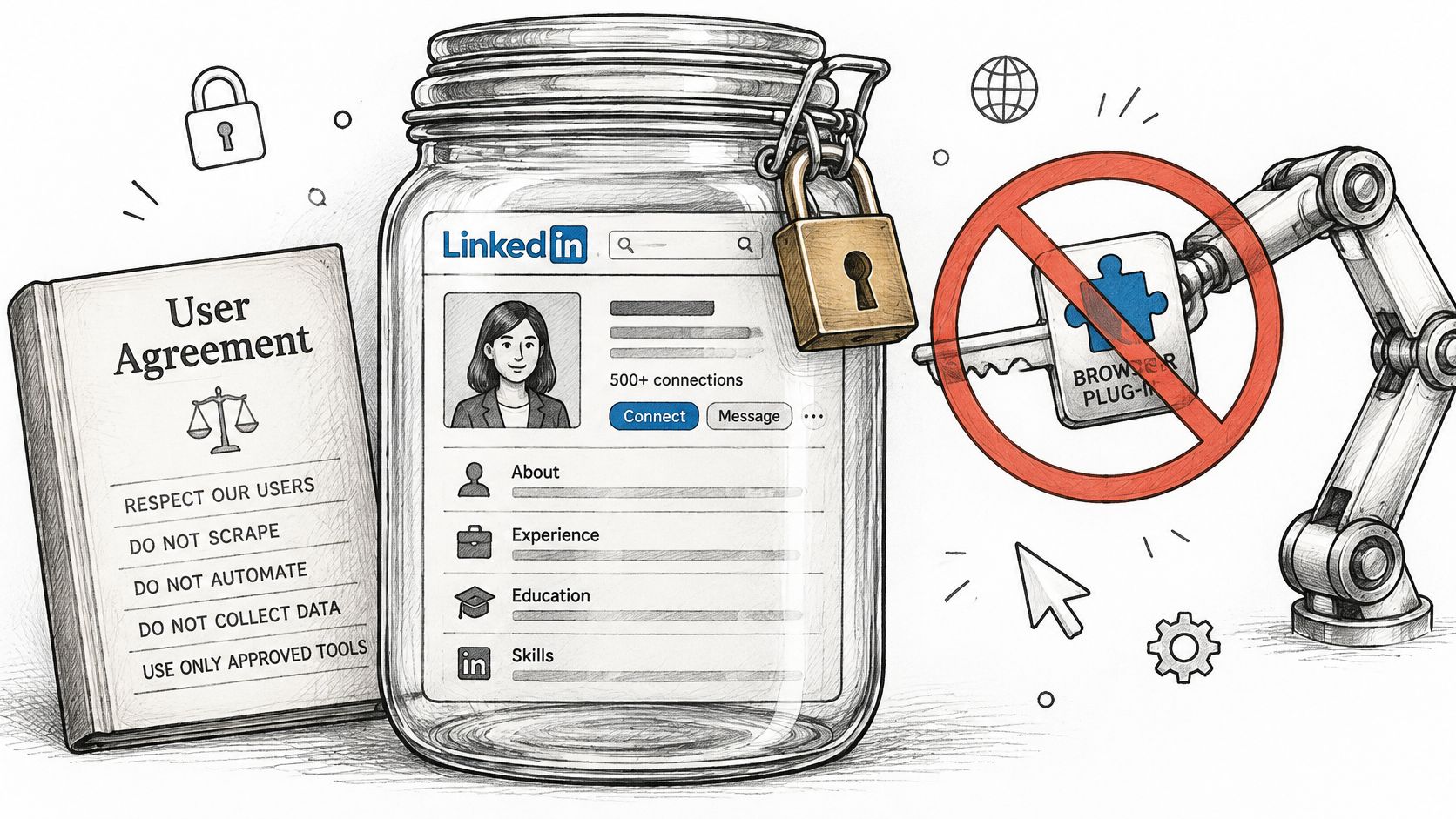
LinkedIn's user agreement guidance prohibits third-party software, crawlers, bots, browser plug-ins and extensions that scrape data or automate activity on LinkedIn, including unauthorized automation used to add contacts or send messages. No outreach tool can guarantee that LinkedIn activity avoids restrictions.
Calling an activity lead generation instead of prospecting doesn't change that policy. Human oversight and restrained activity are operating controls, not permission to use prohibited automation.
Protect the future account relationship
The risk isn't limited to restrictions or low reply rates. Gartner's guidance on B2B buyer preferences and bad prospecting warns that bad prospecting can damage relationships with potential customers.
An aggressive campaign can therefore create an immediate meeting while making other people at the account less willing to engage later. Watch unsubscribes, complaints, domain reputation, repeated non-response and account-level disengagement, not just positive replies.
Compare contacted and uncontacted cohorts over a defined review period, matching them as closely as possible on fit and buying stage. Treat the comparison as a diagnostic, not proof of causation: reps may have selected the more promising accounts to contact.
Verified data helps prevent avoidable sending mistakes, but it doesn't establish permission or relevance. At Flowkon, leads are automatically enriched with verified data before reps reach out; the team still needs to review whom it contacts and why.
Apply channel and legal controls
The FTC's CAN-SPAM compliance guide requires accurate sender and routing information, nondeceptive subject lines, clear identification of commercial messages as advertisements, a clear opt-out method and honoring opt-out requests. B2B email isn't exempt because the recipient uses a work address.
Adopt this checklist before the next launch:
Review messages manually. Check the observation, claims and proposed next step.
Control daily volume. Set conservative operating levels without treating them as guaranteed safe LinkedIn limits.
Monitor delivery. Verify emails, inspect bounces and pause problematic sends.
Centralize suppression. Keep opt-outs out of every active campaign.
Assign ownership. Prevent colleagues from approaching the same account independently.
Pause on negative signals. Investigate disengagement instead of adding more follow-ups.
A message that fails the legal checks creates exposure before it creates a useful conversation.
Choosing the Right Motion for Your Situation
In 2025, 63% of B2B leads took at least three months to make a purchase decision, according to Sopro's State of Prospecting 2025 report as summarized by Sales & Marketing. Don't build a plan that assumes everyone on a target list is ready for a buying conversation.
| Situation | Lead generation first | Prospecting first | Reason |
|---|---|---|---|
| New market with little brand recognition | Build searchable content and proof points | Short outreach to a small named list | Buyers cannot shortlist a company they have never seen |
| Named enterprise accounts | Support with account-relevant content | Lead with prospecting | The target list already exists |
| High-volume inbound with a short sales cycle | Route captured leads to sales quickly | Not needed for most leads | Speed of response matters more than additional outreach |
| Event attendees and existing contacts | Capture and enrich attendee data | Follow up with a timed sequence | Shared context makes the first message easier to write |
| Narrow buyer list with few searches | Limited value as an acquisition motion | Main motion | Direct contact introduces the problem and offer |
Fix the motion with the weakest handoff first. More content won't repair neglected demo requests, and more SDR activity won't repair a list that includes companies you can't serve.
Choose according to the constraint
For a founder entering a new market, I would pair a small prospecting campaign with useful, ungated product education. Conversations test whether the problem description makes sense; the content gives recipients somewhere credible to investigate without committing to a call.
For an enterprise sales team, start with account selection and stakeholder responsibilities. A procurement contact, an operational user and a security reviewer need different reasons to engage. Don't send identical messages across the buying group just because they share an employer.
Agencies need another layer: client-specific qualification rules and suppression. Keep each client's account criteria, claims, approval process and reporting separate. A reusable sequence structure is helpful; a reusable business argument usually needs more work.
When the buyer list is narrow, sharpen the ideal customer profile used in sales before expanding outreach. Exclude accounts that lack a necessary integration, operating model or serviceable geography. Those exclusions protect rep time and make campaign findings easier to interpret.
Lead generation decides who can find you, and prospecting decides who you go to first.
Join the motions around a useful question
Route explicit, high-intent requests directly to the responsible rep. For identifiable accounts repeatedly engaging with pricing, implementation or security material, investigate whether there's an unresolved evaluation question before enrolling anyone.
For example, an integration-page visit might justify offering a compatibility checklist. It doesn't justify claiming you know the visitor's project or budget. Use behavior as a clue, not as a script that reveals everything you've tracked.
A strong first question could be: “Are you checking whether [system] can support [workflow], or are you still comparing approaches?” That gives the buyer room to correct the assumption.
Keep suitable accounts in self-service when there's no useful sales contribution to make. A content download shouldn't automatically trigger a meeting request.
Run a bounded operating test
Map current sources and outreach. Include forms, events, referrals, existing contacts and rep-built lists. Identify duplicates and unowned queues.
Check CRM continuity. Inspect actual records to confirm that source and campaign remain attached after assignment, reply and opportunity creation.
Choose one motion and one primary metric. Use qualified-lead rate for an acquisition-quality problem or opportunities per contacted account for a prospecting-quality problem. Keep negative signals visible alongside it.
Configure the sequence deliberately. Set delays, response handling and stop conditions before enrollment. Review every branch as though you were the recipient.
Review after a fixed period. Compare meetings and opportunities per target account, then inspect the conversations behind the totals. Separate a weak offer from a weak list before changing both.
Flowkon's setup covers profile connection, sequence building from a pre-built template, and prospect import from Sales Navigator or CSV. Its campaigns combine LinkedIn and email in one visual sequence builder, with a shared inbox, reply detection and behavior-based branching. Those capabilities organize execution; they don't replace account judgement or remove platform-policy obligations.
Before launch, confirm verified contacts, opt-out handling, conservative daily volume and a named owner for each stage. Give the receiving account executive enough context to continue the conversation rather than repeat the SDR's questions.
This week, build a target account list small enough to review by hand. Write a specific reason for approaching each account, choose a fixed evaluation period, and run one sequence whose results you can inspect conversation by conversation.
Flowkon offers a visual LinkedIn-and-email sequence builder and shared inbox to manage the handoff from selected prospect to active conversation. Visit Flowkon to try that workflow with your reviewed target list through a 7-day free trial, with no credit card required.