.png)
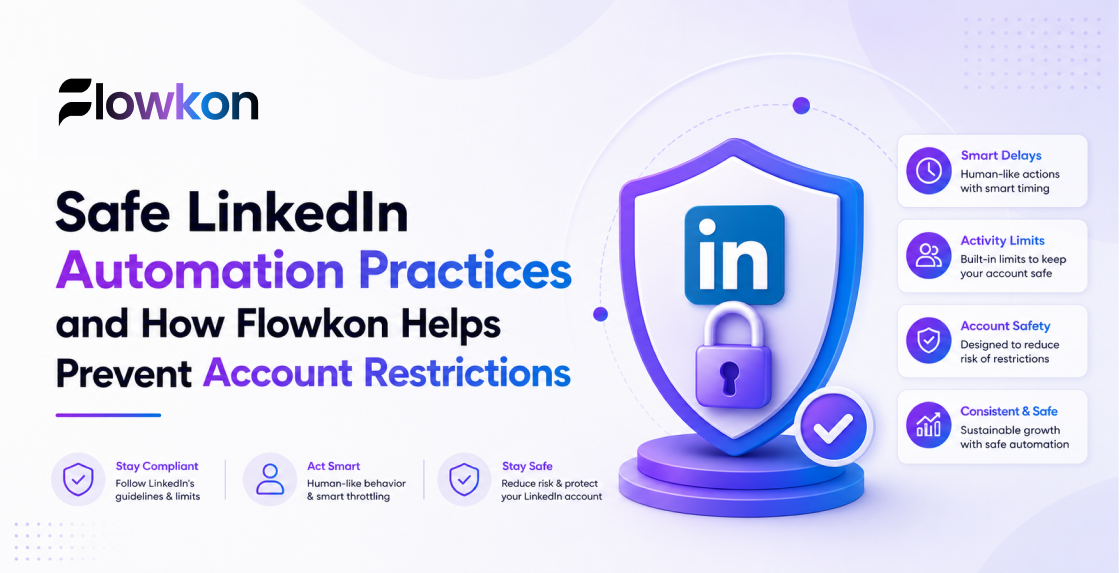
LinkedIn has become the most trusted channel where most B2B conversations actually start. That's why so many sales and recruiting teams turn to a LinkedIn automation tool, to send connection requests, follow up, and keep campaigns moving without someone tied to their inbox all day.
But automation has a mixed reputation. Push it too hard, and you risk the exact restriction you are trying to avoid; avoid it entirely, and you are leaving efficiency on the table. The truth sits in between: LinkedIn outreach automation carries real risk only when it ignores how a real person actually behaves on the platform.
This article covers what safe automation actually looks like, why accounts get flagged, and where a multichannel campaign fits in to cut down how much you depend on LinkedIn alone, including how Flowkon is built around these same principles.
What Is LinkedIn Automation?
LinkedIn automation refers to software that handles repetitive parts of your outreach process, the tasks that don't need a fresh decision every single time, but still need to happen consistently. It's not a replacement for a sales or recruiting strategy. It's infrastructure that lets a strategy run without someone manually clicking through profiles all day.
Most teams use automation for a handful of specific jobs:
Prospect research. Building lists of people who match a target role, industry, or company size, instead of searching manually one profile at a time.
Connection management. Sending connection requests to a defined list and tracking who accepts, rather than doing it one by one from the LinkedIn interface.
Follow-ups. Sending a second or third message to people who haven't replied yet, on a schedule, so no lead falls through simply because someone forgot to check back in.
Campaign scheduling. Spacing out messages and actions over days or weeks instead of sending everything at once.
Lead organization. Keeping track of who's been contacted, who replied, and who's ready for a follow-up call, usually synced with a CRM.
None of these tasks require automation to think like a human. They require it to behave consistently and follow the pacing a human would use if they had unlimited time and patience. That distinction matters, because the moment automation is used to replace the conversation itself - sending generic pitches at scale and hoping something sticks - it stops supporting your outreach and starts working against it. The goal is always to get automation to do the repetitive parts so your team can spend their time on the part that actually needs a person: the reply, the call, the negotiation.
Can LinkedIn Automation Get Your Account Restricted?
Yes, it can. There's no honest way to write this article without saying that plainly. LinkedIn's terms of service don't permit third-party automation tools, and the platform actively looks for behavior patterns that suggest a script is running rather than a person.
That doesn't mean every account running automation gets restricted, or that restrictions only happen to people using tools. Plenty of accounts get flagged for manual behavior too; sending too many connection requests by hand in a short window is just as risky as doing it through software. What LinkedIn is actually watching for isn't the presence of a tool. It's an activity that doesn't look like normal professional use.
A few patterns tend to trigger scrutiny:
Excessive connection requests
LinkedIn has weekly limits on connection requests, and while the exact number isn't published and changes over time, sending requests far beyond what a person could reasonably send by hand is one of the fastest ways to get flagged.
Spam-like messaging
Sending the same message to hundreds of people in a short period of time looks nothing like how people actually communicate on the platform.
Poor targeting
Sending connection requests to irrelevant prospects can hurt your LinkedIn performance. If your outreach targets the wrong industry, job level, or location, recipients are more likely to ignore your request or select "I don't know this person," both of which can signal poor targeting to LinkedIn.
Repetitive, identical actions
Visiting profiles in the same sequence, at the same interval, day after day, is a pattern a script produces, but a person rarely does.
Multiple tools running on one account
Some teams stack two or three automation tools on a single account, each unaware of what the other is doing. The combined activity often looks nothing like a single person's normal usage.
Unnatural activity patterns
Actions happening at 3 a.m., or a sudden jump from ten connection requests a day to two hundred, stand out against a normal usage baseline.
None of this means automation is off the table. It means automation needs to be built and used with these patterns in mind, rather than treated as a way to bypass them entirely.
Common LinkedIn Automation Mistakes Businesses Should Avoid
Most restriction stories trace back to a small number of avoidable mistakes. Here's what tends to cause the most damage.
Sending too many connection requests
A common mistake, especially with new accounts, is trying to grow a network quickly by sending as many requests as the platform will technically allow. A brand-new account behaving like it's been active for years is one of the more obvious red flags.
Using identical messages for everyone
Copy-pasting the same opener to a VP of Engineering and a Marketing Coordinator, with no adjustment for role or context, reads as spam even before LinkedIn's systems get involved; the recipient notices first, and the low response rate that follows often does more damage to a campaign than any restriction would.
Ignoring personalization entirely
There's a difference between “Hi {{firstName}}, I wanted to reach out about.” and a message that references something specific about the person's role, recent activity, or company. The first is a mail-merge with a first name inserted. The second reads like it was written for that person.
Targeting the wrong audience
If your list includes people who are nowhere near your buyer or candidate profile, you'll see more ignored requests and “I don't know this person” reports, both of which count against your account's standing over time.
Sending too many follow-ups
A third or fourth follow-up to someone who hasn't responded to the first two isn't persistence; it's noise. Beyond a certain point, more follow-ups increase the chance of a spam report rather than a reply.
Automating without monitoring responses
Some teams set up a campaign, let it run, and check back a week later. If a message isn't landing, or if people are responding negatively, that needs to be caught within a day or two, not after hundreds of messages have already gone out with the same problem.
Each of these mistakes is fixable, and most of them come down to treating automation as something you configure once and forget, rather than something you actively manage.
Safe LinkedIn Automation Best Practices
Build and Maintain a Professional Profile
Before any outreach starts, your profile needs to look like it belongs to someone real: a complete work history, a profile photo, a clear headline, and some existing activity. Automation running from a bare, half-finished profile stands out immediately, both to the people you are contacting and to LinkedIn's own systems. This matters even more for accounts that are new to the platform; if you are setting up outreach on a fresh profile, it helps to warm up your LinkedIn account before starting automation rather than jumping straight into full campaign volume.
Start Slowly and Maintain Consistent Activity
New accounts, or accounts that haven't been active in a while, should ramp up gradually. Start with a modest number of connection requests and messages per day, and increase volume over a couple of weeks rather than all at once. Consistency is the key to safest LinkedIn automation. Steady engagement week after week is more likely to reflect genuine account usage and less likely to trigger automated risk signals.
Keep Outreach Relevant
Every message should have a reason to exist. If you can't explain in one sentence why this specific person is getting this specific message, the targeting needs work before the campaign goes live. Relevant outreach also just performs better - higher reply rates, fewer ignored requests, less risk overall.
Personalize Messages
Personalization doesn't mean writing every message from scratch. It means using enough context: company, role, industry, or a specific trigger like a recent job change or company announcement - that the message reads as intended for that person, not blasted to a list. Even light personalization, like referencing someone's specific team or a recent post, changes how a message is received.
Use Proper Campaign Timing
Schedule your outreach at regular intervals instead of sending all connection requests and messages at once. Send connection requests, add reasonable delays between profile visits, and avoid running your highest-volume activity all at the exact same time every day. If you're managing outreach across multiple people or campaigns, it also helps to build a scalable LinkedIn outreach system that accounts for pacing from the start, rather than updating limits after volume has already grown.
Monitor Replies and Adjust Campaigns
Check in on active campaigns regularly, not just to log replies, but to catch problems early. A sudden drop in acceptance rate, an uptick in negative responses, or messages that consistently go unanswered are signals that something in the targeting or copy needs to change before you scale further.
Combine Automation With Human Interaction
The safest and most effective outreach uses automation for the repetitive groundwork and hands off to a person the moment a real conversation starts. Automated follow-ups can nudge a lead, but the actual back-and-forth answering questions, handling objections, and booking the call should come from someone on your team, not a script pretending to be one.
Getting these fundamentals right takes real, ongoing attention, which is part of why so many teams look for a platform that builds these guardrails in rather than leaving pacing and personalization entirely up to manual configuration. Explore how Flowkon can help you set up campaigns that follow these practices by default.
How Flowkon Helps Businesses Run Safer LinkedIn Outreach
Flowkon isn't a way around LinkedIn's limits, and it doesn't promise your account will never be restricted - no honest tool can make that promise, because a lot depends on account age, past activity, and how a campaign is configured. What Flowkon focuses on instead is making it easier to follow the practices outlined above, consistently, without needing to manually track pacing, personalization, and timing across every campaign.
Smart Activity Management
Flowkon manages outreach volume within ranges that reflect realistic usage. Campaigns are organized so activity builds gradually instead of spiking, and connection requests, messages, and profile visits are spaced out rather than fired in a short burst. The goal is outreach that stays within a pattern LinkedIn would expect from an active professional, not the ceiling of what's technically possible.
Personalized Messaging
Rather than sending one message to an entire list, Flowkon uses personalization outreach to adjust messaging based on the details available for each contact: role, company, industry, and relevant context pulled from their profile. This isn't about writing something dramatically different for each person; it's about avoiding the flat, obviously-templated messages that hurt both reply rates and account standing.
Campaign Scheduling
Outreach sequences in Flowkon are built as structured, multi-step flows with an initial message, planned follow-ups, and defined stopping points, rather than one message repeated indefinitely. This keeps follow-up cadence reasonable and makes it easy to see exactly where each contact sits in the sequence, instead of guessing whether someone's already been messaged three times.
Multichannel Outreach
Because Flowkon supports LinkedIn and email in the same workflow, outreach doesn't need to rely entirely on one channel. A prospect who doesn't respond on LinkedIn can be reached by email, and vice versa, which spreads activity across channels instead of concentrating everything on a single LinkedIn account. Teams that combine LinkedIn Outreach with email campaigns generally create more touchpoints without relying exclusively on LinkedIn activity.
Monitoring and Control
Flowkon gives visibility into how campaigns are performing, like acceptance rates, reply rates, and activity levels, so teams can catch issues early and adjust before a problem compounds. Campaigns can be paused, slowed down, or reconfigured directly, which matters more than most people expect: the ability to react quickly to a dip in performance is often what separates a manageable issue from a bigger one.
Used this way, Flowkon functions less like a tool that runs in the background unsupervised, and more like a system that helps a team apply good outreach habits consistently, campaign after campaign. If you're currently managing pacing and personalization manually across spreadsheets and reminders, start building a more organized outreach process with a platform that handles the structure for you.
“If you are currently managing pacing and personalization manually across spreadsheets and reminders, start building a more organized outreach process with a platform that handles the structure for you.”
LinkedIn Automation Safety Checklist
Before launching or scaling a LinkedIn outreach campaign, run through this list:
- Define your target audience clearly, based on role, industry, and company fit
- Personalize your messages using relevant, specific context
- Avoid excessive activity - stay well within reasonable daily and weekly limits.
- Monitor campaign performance regularly, not just at the end of a sequence.
- Maintain a professional, complete profile before starting outreach
- Focus on starting conversations, not maximizing volume
This isn't a one-time setup. Revisiting this checklist every time you launch a new campaign, or scale up an existing one, catches most of the issues before they turn into a bigger problem.
What To Do If LinkedIn Restricts Your Account
If a restriction does happen, how you respond matters as much as what caused it in the first place.
Pause all campaigns immediately. Continuing to run automation on a restricted or flagged account tends to make things worse, not better.
Review your recent activity. Look at connection request volume, message frequency, and targeting over the past two to three weeks. Most restrictions trace back to a specific spike or pattern, and identifying it helps you avoid repeating it.
Check your messaging approach. If your messages were generic, overly frequent, or poorly targeted, that's worth fixing regardless of the restriction; it's likely hurting your reply rates too.
Improve your targeting. Tighten your ideal customer or candidate profile so future outreach goes to people who are genuinely likely to engage, reducing the ignored requests and reports that contribute to restrictions.
Resume slowly. Once activity is restored, start at a lower volume than before and build back up gradually over a couple of weeks, rather than returning immediately to your previous pace.
There's no guaranteed timeline for how long a restriction lasts, and LinkedIn doesn't publish specifics on what triggered it in any individual case. Treating it as a signal to adjust your approach, rather than a problem to argue your way out of, tends to produce better outcomes.
“If you're building out a LinkedIn outreach process and want the structure, pacing, and personalization to be handled for you rather than managed manually, explore how Flowkon can help you get started.”


.png)