

Most deals don't die during a dramatic objection. They fade slowly after the first message, when nobody checked whether the account was a fit, nobody followed up while interest was fresh, and the CRM still shows a hopeful stage with no evidence behind it.
The best practices for sales below fix that gap in the order a deal moves. You'll see how to choose better prospects, open conversations without pitching too early, handle hesitation, build a follow-up system, and keep your pipeline honest. The aim isn't clever wording. It's consistent execution backed by genuine curiosity about the buyer.
A practical conversion process also needs clear movement between stages. This conversion guide from Prometheus Agency is useful when you're reviewing where interested prospects stop progressing.
Research and Qualify Leads Before Outreach
A large prospect list can hide a weak sales process. If you contact people who lack the problem, authority, budget, or timing to buy, better copy won't rescue the campaign. Qualification protects your time and gives you a reason to contact someone beyond “I'd love to connect.”
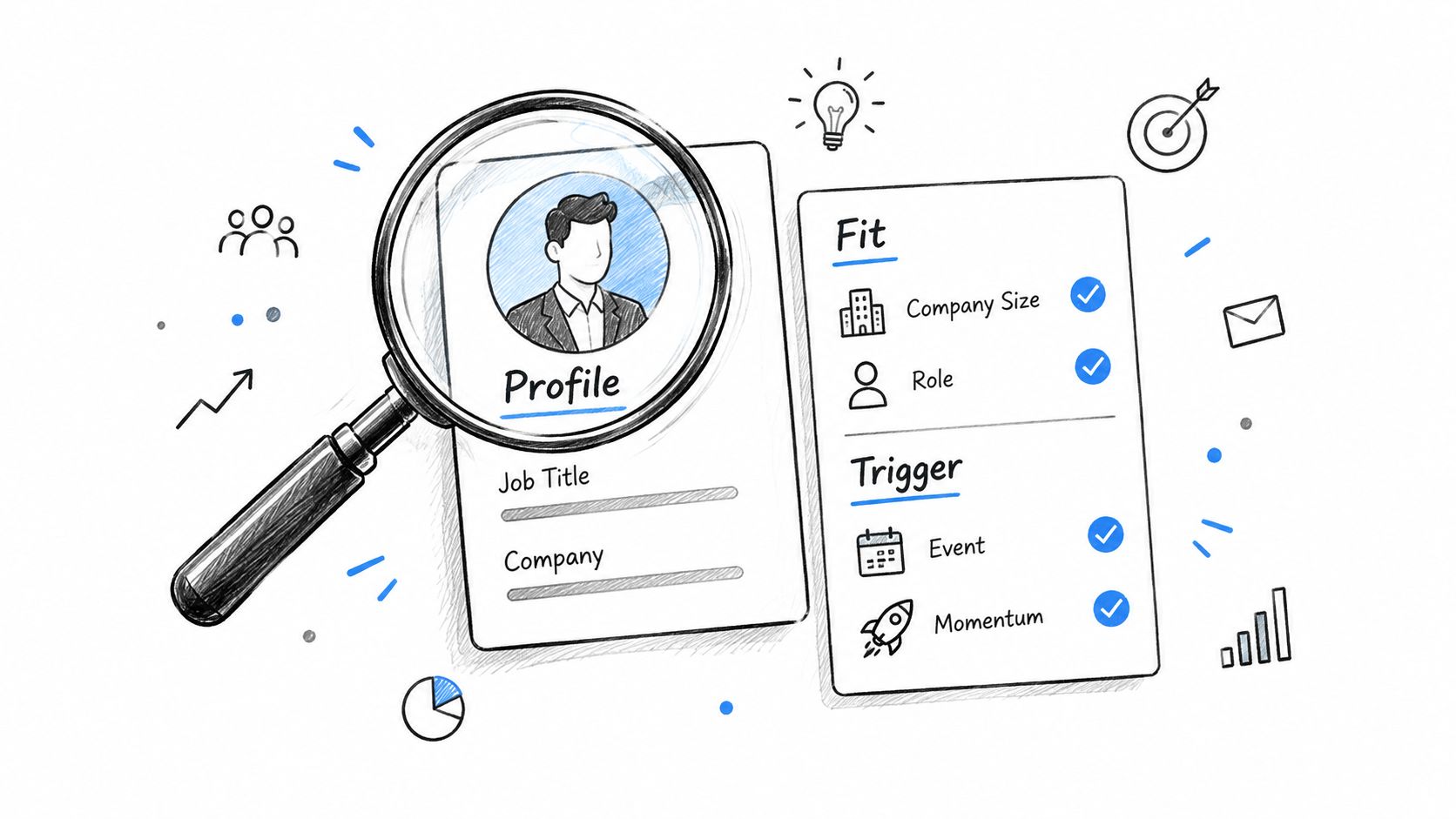
Start with an ICP checklist. Include the company's industry, size, operating model, likely use case, buyer role, and signals that the problem is active. Then look for public evidence such as a leadership change, hiring activity, product launch, funding announcement, or expansion into a new market.
A VP of Sales at a growing B2B software company who's hiring sales operations staff may be worth prioritizing. The relevant opening isn't your product list. It's a question about how the team is managing process and visibility while it scales.
Use a simple qualification workflow
- Filter for fit: Remove accounts that clearly fall outside your service model or customer profile.
- Check the trigger: Find a recent event that could make the problem more urgent.
- Identify the person: Confirm the contact's role and likely influence over the purchase.
- Write one hook: Record a specific observation before you open your outreach tool.
- Set a stop rule: Don't sequence a prospect when the evidence is too weak.
Use company research tools and LinkedIn Sales Navigator to build focused lists rather than pulling random contacts from a database. Combine automated enrichment, such as Flowkon's Email Finder, with manual review for priority accounts. This guide to B2B sales prospecting tools can help you compare the research stack before you add another tool.
Practical rule: Research should give you a credible reason to start a conversation, not a fictional reason to force one.
The trade-off is straightforward. More research improves relevance but limits volume. For high-value accounts, spend the time. For a lower-value segment, use a tighter checklist and remove poor fits quickly.
Personalize with One Profile-Specific Detail, Not Generic Templates
A rep opens their sequence tool, drops in first name, company, and title, then wonders why the message still feels cold. The problem usually is not the template. It is that nothing in the note proves this was written for this buyer, in this situation, right now.
The workable standard is simple. Keep the structure repeatable, then earn attention with one profile-specific detail that changes the opening line or question. Flowkon's practical approach is to auto-fill basics such as first name, job title, company, and industry, then add one researched detail tied to the prospect or segment. Good options include a recent role change, a company announcement, or a public post that signals a relevant problem.
Here is a version that holds up in practice:
Hi [First Name]. I noticed you recently joined [Company] as [Job Title]. I saw that the team is expanding its revenue operation, so I was curious how you're handling [relevant challenge]. Is that a priority this quarter?
That works because the message gives the buyer a reason to reply beyond politeness. It points to a visible signal, names a likely issue, and asks a question they can answer quickly.
Keep the rest of the sequence stable. Change the hook by segment. A VP of Sales may care about scaling process. A healthcare recruiter may care about hiring timelines and compliance. Same frame, different angle.
A few rules keep this from getting awkward:
- Use visible evidence: Mention something the prospect would recognize immediately.
- Keep it brief: One sharp sentence beats a paragraph that feels invasive.
- Batch similar accounts: Build angles by role, industry, or company stage.
- Test small cohorts: Read the replies before sending across the full list.
- Stop on reply: Once someone answers, the sequence is over and the conversation starts.
Flowkon's team reported that moving from fully generic templates to one profile-specific line lifted reply rate from 5% to 20% in a campaign described by Flowkon's team. Treat that as one campaign result, not a promise.
The failure mode is easy to spot. Reps decorate a generic pitch with a first name and call it personalization. Real personalization changes the relevance of the message itself. This analysis of the personalization gap explains why a message can contain variables and still feel automated. For team design, this perspective on achieving personalized outreach at scale is also useful.
Ask Better Discovery Questions Instead of Pitching Early
A rep gets the meeting, hears a buying signal, and starts explaining the product in minute two. Ten minutes later, the buyer is polite, the demo is booked, and the deal is already weaker than it looks. Nobody has pinned down what is broken, how painful it is, or whether the issue is strong enough to survive procurement, budget review, and internal debate.
Discovery starts earlier than the call. Even your first outbound note tests a hypothesis. The job is to name a situation the prospect may recognize, then ask a question they can answer from their own reality.
You've grown quickly over the past year. How are you managing retention as the team scales?
That works because it opens a door without pretending you already know the floor plan. Sometimes the answer is useful. Sometimes the buyer says retention is fine and another issue matters more. That is still progress, because you learned where not to sell.
Once you're live, slow the conversation down enough to get specifics. I look for four things in order: how the work happens today, where it breaks, what the breakage costs, and what changes if they fix it. Huthwaite organizes that flow as Situation, Problem, Implication, and Need-payoff questions. In the SPIN research from Huthwaite International, the firm explains the methodology behind the framework and reports productivity gains in controlled implementation projects.
A practical call track looks like this:
“Walk me through how you handle this today.”
“Where does that process create friction?”
“What happens when that issue stays unresolved for another quarter?”
“If you improved that, what would change for the team or the business?”
Good reps do more than ask the questions. They listen for constraints and buying conditions hidden in the answer: budget pressure, team capacity, timing, internal politics, and the exact words the buyer uses. Those words should show up in the follow-up. “You mentioned data gets stale between meetings” is sharper than “Following up on our discussion.”
There is a trade-off. A question-led conversation can feel slower than a polished pitch, and some reps get nervous in the silence. In complex sales, that slower start usually produces a better pipeline because you are qualifying while you learn, not collecting demos that stall later.
Sell Outcomes and Value, Not Features
Features are easy for sellers to memorize and easy for buyers to ignore. The buyer wants to know what changes in their working day, budget, risk profile, or ability to hit a target.
Translate each feature into a buyer outcome. A centralized inbox isn't valuable because it has multiple channels. It matters if the team stops missing replies spread across LinkedIn and email. CRM synchronization isn't valuable because records update automatically. It matters if managers can trust pipeline data without asking reps to reconstruct every interaction.
Use this conversion exercise before a campaign or demo:
- Feature: What does the product do?
- Current friction: What does the buyer struggle with now?
- Outcome: What improves if that friction disappears?
- Proof: What evidence can you show without overstating the result?
A message might say:
Your team is checking LinkedIn and email separately, so replies can sit unseen. We bring those conversations into one workflow so the owner can respond from the same place and the sequence can stop when the prospect engages.
That is more useful than listing “unified inbox,” “conditional logic,” and “real-time synchronization.”
Build value by role
A founder may care about pipeline visibility and time. An SDR may care about clear next actions and less manual research. A RevOps leader may care about field consistency, permissions, and attribution. One feature can support all three, but the message shouldn't sound identical.
Don't invent a financial return to make the outcome sound concrete. If you have verified customer evidence, use it. If you don't, describe the operational improvement clearly and ask the buyer to estimate its value.
The common failure is leading with value claims that the prospect hasn't confirmed. Say, “If missed replies are slowing follow-up, this workflow may help,” not, “This will transform your conversion rate.” Specificity builds confidence, but false precision destroys it.
Handle Objections as Information, Not Rejection
You finish a solid demo, the buyer nods along, then says, “The price is too high.” That moment tempts reps to defend the proposal line by line. Usually that makes things worse. An objection is a location marker. It shows where confidence broke down in the deal.
Start by slowing the conversation down.
I hear that budget is a concern. Is the issue the total investment, or is there a specific part of the proposal that doesn't feel justified yet?
That one question helps you sort four very different situations: they can't afford it, the project lost priority, the scope is off, or the value still feels unproven. Each one needs a different response, and treating them as the same objection is how deals drift.
I use a simple sequence in live calls: pause, acknowledge, clarify, respond, confirm. Then decide whether the deal should move. You do not need a formal checklist on the screen, but you do need the discipline. If a buyer says, “We need to think about it,” give them room, then ask:
Of course. What questions should I answer so you can evaluate it properly, and when are you planning to make the decision?
The trade-off is straightforward. Push too hard and you create resistance. Back off too early and you leave a vague stall sitting in the pipeline.
Competitor objections need the same calm approach. Don't argue that the current vendor is weak. Ask:
What's working well with them today, and where do you still have friction?
Sometimes the honest answer is that the account is stable and there is no real opening. Good. That saves time and keeps the forecast cleaner. Other times you hear a usable gap, usually around reporting, ownership, or workflow flexibility, and now the conversation has substance.
Proof only helps when it matches the concern. If implementation capacity is the blocker, a case study about results will not resolve it. Offer the proof that fits, confirm whether it answered the issue, and if the buyer still cannot name a question, timeline, or next action, mark the record accurately and move on.
Follow Up Consistently with Sequenced Timing and Multiple Channels
A lead fills out a form at 10:02. By 2:00, three other vendors have already replied, and your rep is still planning the first touch. That deal is not dead, but you are now working from behind.
Speed matters because intent fades fast. In the speed-to-lead statistics compiled from the HBR lead-response study, researchers examining online lead handling across 2,241 U.S. companies found that contacting a lead within an hour made qualification nearly seven times more likely than waiting an additional hour. The same analysis reported that waiting at least a day made meaningful contact about 60 times less likely than responding within the first hour.
A separate study associated with InsideSales.com and James Oldroyd looked at more than 15,000 leads. It found that trying to make contact within five minutes made qualification 21 times more likely than waiting 30 minutes, and the odds of making contact were reported as 100 times higher. The practical takeaway is straightforward. Route the inquiry immediately, assign one owner, and trigger a relevant first response within minutes.
Then build the follow-up around conditions, not fixed delays alone.
- First touch: Send a researched LinkedIn connection request with one specific hook.
- If accepted: Follow with a short LinkedIn message that continues the same thread.
- If LinkedIn stays quiet: Plan an email touch that refers to the same issue but adds a new question or useful context. Check for a reply before sending it so the prospect doesn't receive a duplicate ask.
- If they reply on either channel: Stop the planned touches and have the account owner take over.
- If there's still no response: Move the contact into nurture instead of repeating the pitch.
Flowkon's multichannel campaigns let teams plan LinkedIn connection requests, follow-ups, and email touchpoints in one flow with clear timing and logic. The handoff is not a reason to send the same message twice: use email when the LinkedIn conversation has not started, keep the context consistent, and check for engagement before the next touch. Once a buyer answers, a person should take over the conversation.
Here is a simple script I'd use after a LinkedIn accept:
Thanks for connecting. You mentioned hiring for outbound growth, so I thought I'd reach out directly. Are you trying to improve reply quality, booking volume, or pipeline coverage this quarter?
The common failure mode is repetition. Reps send the same ask in three channels, then wonder why the buyer goes silent. Flowkon's multichannel workflow combines LinkedIn and email specifically to avoid that kind of double-messaging. The trade-off is control. More channels can raise coverage, but they also raise the chance of sloppy timing, compliance issues, and mixed records if ownership is unclear.
Vary the reason for each touch. Start with a short question, follow with one relevant resource, then send a clean close-out message. Review deliverability, opt-outs, replies, and meeting quality, not just activity volume.
LinkedIn's rules also matter. LinkedIn's own automation policy says third-party software, including crawlers, bots, browser plug-ins, and extensions, cannot scrape data or automate activity on the site. That includes automated contact management, messaging, and engagement. Pacing and review controls may reduce operational risk, but they do not make prohibited activity acceptable under the policy.
Build Trust and Long-Term Relationships, Not Just Transactional Deals
A prospect who says “not now” isn't necessarily rejecting your company. Their priorities, budget, leadership, or internal project may change. The relationship survives only if you leave the interaction with respect and then do what you said you'd do.
When a buyer isn't ready, try:
That makes sense. I'll send one relevant resource and check in after your planning cycle. If the priority changes sooner, you can reach me directly.
Then record the reason and the agreed timing. Don't put every “not now” lead into a generic newsletter and hope for the best. Add a specific re-entry angle.
Flowkon handles LinkedIn leads beyond the first connection request. Its LinkedIn Inbox keeps chats in one place, and its CRM integrations can push LinkedIn leads into HubSpot or sync them with Zoho CRM. For accepted but quiet prospects, Flowkon's team tags the lead in the CRM and re-engages after 30 to 45 days with a different angle, such as a short question or relevant insight rather than another product pitch. Pending invitations that remain unanswered are cleared with Flowkon's Auto-Withdraw Threshold after a configured period.
Treat the handoff as part of selling
Trust often breaks after the contract because the seller disappears or promises were never documented. Before closing, confirm:
- Ownership: Who handles onboarding and questions?
- Success condition: What must be true for the buyer to call the project successful?
- First milestone: What happens immediately after signing?
- Communication rhythm: When will both sides review progress?
For new customers, schedule early check-ins around the actual implementation rather than your commission calendar. Ask, “What's blocked?” and “What changed since we last spoke?” A useful relationship creates future expansion and referrals, but those follow naturally from delivered value. Asking for an introduction before proving anything makes the relationship feel transactional.
Use CRM Data Strategically to Track, Measure, and Improve
A CRM isn't a storage cupboard for contacts. It's the team's memory and the manager's evidence. If the record says “proposal sent” but contains no buyer, decision process, problem, or next date, the stage is fiction.
Define the minimum data required for a deal to move. That might include the verified problem, business impact, decision participants, timing, current solution, next commitment, and reason for loss. Keep the fields limited enough that reps can update them during the workday.
Measure the process buyers experience
Track metrics that connect activity to progression:
- Lead response time: How quickly does an owner respond after an inquiry?
- Positive reply rate: Which segments create real conversations?
- Qualified meeting rate: Are meetings with the right accounts?
- Stage aging: Where do opportunities stop moving?
- Win rate by source: Which channels produce customers, not just contacts?
- CRM completeness: Can a manager understand the deal without asking the rep?
Don't reward activity in isolation. A crowded dashboard can hide weak targeting and poor conversations. Salesforce's 2024 research surveyed 5,500 sales professionals across North America, Latin America, Asia-Pacific, and Europe. It reported that 81% of sales teams were experimenting with or had fully implemented AI. Among those organizations, 83% reported revenue growth in the prior year, compared with 66% of teams without AI. The research also reported that one-third of sales operations professionals cited insufficient resources or training as adoption barriers. Read the Salesforce sales AI research for the study context.
The practical point isn't to buy automation because the market is excited about it. Automate repetitive capture and routing only after defining the fields and quality checks. On its Professional and Custom plans, Flowkon's CRM integrations automatically sync contacts, activities, and replies. Flowkon integrates with Salesforce, HubSpot, Monday.com, Zoho, and Pipedrive. Its dashboard and analytics features help teams inspect campaign and funnel performance. A manager should still review whether the synced data reflects reality.
Use Stories and Social Proof to Build Credibility
Buyers hear product claims all day. They trust a specific customer situation more because it gives them something to compare with their own environment.
A useful story has four parts: the starting problem, the constraint, the change, and the business meaning. “We improve sales efficiency” is a claim. “The team was losing track of replies across channels, introduced one owner per conversation, and created a cleaner handoff” is a story that invites useful questions.
Match proof to the buyer's concern
If the prospect worries about adoption, show how another team introduced the process gradually. If they worry about data quality, show the validation and ownership steps. If they worry about relevance, choose a customer with a similar role, industry, or operating model.
Use customer evidence carefully. Don't invent a result, round a number upward, or attach a quote to a customer who hasn't approved it. Ask for permission before using a name, logo, or direct quotation. If the customer prefers anonymity, describe the situation accurately without adding details that identify them.
A short outreach example:
You mentioned that your team is adding more reps without a clear view of follow-up ownership. We've seen a similar issue in teams running LinkedIn and email separately. Would it be useful if I sent over the workflow they used to keep replies and next steps together?
That message uses a story as an invitation, not as a manufactured success claim.
During a call, don't dump a case study into the conversation. Ask permission first, then connect one part of the story to the buyer's stated concern. “Would it help to see how another team handled that handoff?” gives the prospect control and keeps the evidence relevant.
Close Naturally by Clarifying Next Steps, Not Pushing
You finish a solid demo. The buyer is engaged, asks specific questions, and says, “This looks good. I need to run it by the team.” That sentence can mean real momentum, or a polite stall. The close is where you find out which one you have.
A good close makes the next commitment concrete. It does not add pressure at the last minute. If the earlier stages were handled well, you are not trying to force a yes. You are helping the buyer define what happens next, who owns it, and when it happens.
Here's a simple way to handle that moment on the call:
Based on what we covered, does this look worth discussing with the rest of your team?
If the answer is yes, keep going:
What does the buying process look like from here, and who else needs to be involved?
Then turn that into one clear action. “Let's reconnect soon” usually means nothing. “Let's meet Thursday with your operations lead to review the implementation questions” gives the deal a real path.
I usually listen for one thing here: do they name a process, or do they stay vague?
When the buyer is serious, they can usually tell you who needs to weigh in, what concern is still open, and what timing is realistic. When they cannot, the right move is to clarify the gap instead of filling the silence with a discount, a harder pitch, or fake urgency.
A practical close often sounds like this in sequence: confirm the solution fits the problem they described, ask what could block a decision, identify the reviewers, agree on timing, assign ownership for the next step, then send the recap right away.
If they say they need to talk internally, ask when that conversation will happen and offer a short summary they can forward. If there is no date, say:
I understand. Would it be useful to leave this open, or should we close it for now and revisit if the priority changes?
That protects the forecast and keeps the relationship intact. Some deals need one fix. Some should close out cleanly. Both outcomes are better than a pipeline full of maybes.
Top 10 Sales Best Practices Comparison
TacticImplementation complexity 🔄Resource requirements ⚡Expected outcome 📊⭐Ideal use cases 💡Key advantages ⭐Research and Qualify Leads Before OutreachHigh 🔄, detailed per-prospect researchModerate–High ⚡, data tools (LinkedIn SN, enrichment), time per lead📊 Higher reply rates; fewer wasted sequences; shorter sales cycles ⭐Targeted ABM, high-ACV deals, refining ICPBetter-fit pipeline; genuine personalization; fewer dead leadsPersonalize with One Profile-Specific Detail, Not Generic TemplatesMedium 🔄, template + one custom hookLow–Medium ⚡, CRM variables + light research per prospect📊 Significant lift in accept/reply rates while scalable ⭐Volume outreach needing authenticity at scaleBalances efficiency and authenticity; easy to testAsk Better Discovery Questions Instead of Pitching EarlyLow–Medium 🔄, training and scriptsLow ⚡, coaching time, rep discipline📊 Higher engagement quality; more consultative conversations ⭐Early outreach and discovery callsUncovers real needs; reduces sales resistanceSell Outcomes and Value, Not FeaturesMedium 🔄, messaging & positioning workMedium ⚡, customer interviews, value frameworks📊 Better conversions; clearer price justification; faster closes ⭐Competitive deals; price-sensitive buyersResonates with buyer priorities; clarifies ROIHandle Objections as Information, Not RejectionLow 🔄, mindset change + templatesLow ⚡, coaching and scripts📊 Improved deal progression; fewer lost opportunities ⭐Mid-stage deals with pushbackReveals true barriers; builds trustFollow Up Consistently with Sequenced Timing and Multiple ChannelsMedium–High 🔄, sequence design & automationMedium ⚡, automation platform, verified contact data📊 Higher meeting/reply rates; scalable cadence performance ⭐Cold outreach, long-cycle sales, nurture campaignsMulti-touch coverage; conditional logic reduces noiseBuild Trust and Long-Term Relationships, Not Just Transactional DealsMedium 🔄, cross-team processes and CS handoffsMedium–High ⚡, CSMs, ongoing content, follow-ups📊 Lower churn, higher LTV, more referrals over time ⭐SaaS/subscription models, expansion-focused accountsSustainable revenue; stronger advocacy and retentionUse CRM Data Strategically to Track, Measure, and ImproveHigh 🔄, governance, fields, reportingMedium ⚡, CRM tooling, integrations, training📊 Better forecasting; repeatable winning campaigns; clear bottlenecks ⭐Scaling teams, performance management, analytics-driven orgsData-driven coaching; objective performance insightsUse Stories and Social Proof to Build CredibilityMedium 🔄, case study production processMedium ⚡, customer interviews, content creation📊 Higher trust and conversions; easier objection handling ⭐Risk-averse buyers; new market entry; late-stage proofMemorable narratives; relatable evidence of impactClose Naturally by Clarifying Next Steps, Not PushingLow 🔄, closing framework and templatesLow ⚡, rep training and discipline📊 Higher close rates; clearer pipeline movement ⭐Demo follow-ups, decision-stage conversationsRemoves ambiguity; collaborative and respectful close
Common Mistakes to Avoid
The same failures appear across founders, SDR teams, agencies, and established sales organizations. They're usually process problems disguised as messaging problems.
- Mass generic outreach: Sending the same pitch to hundreds of people produces activity without relevance. Build smaller segments, use one profile-specific hook, and vary the angle by role or problem.
- Pitching in the first message: A feature list asks the buyer to do too much work before they've expressed a need. Lead with an observation and a question.
- Treating acceptance as interest in a meeting: An accepted connection is permission for a conversation, not proof of buying intent. Continue naturally and qualify.
- Continuing after a reply: Once a prospect responds, automated follow-up can make a human conversation feel careless. Stop the sequence and assign an owner.
- Ignoring compliance: U.S. commercial email must use accurate routing information, avoid deceptive subject lines, identify the message as an advertisement, include a physical postal address, and provide a clear opt-out. The Federal Trade Commission's CAN-SPAM guidance says opt-outs must be honored within 10 business days, and the mechanism must remain capable of processing requests for at least 30 days after the message is sent.
- Treating LinkedIn automation as risk-free: LinkedIn prohibits third-party tools that automate or scrape restricted activity. Internal controls don't equal LinkedIn approval.
- Using a CRM as a reporting ritual: A record updated only before a forecast meeting won't help the rep or manager. Make updates part of the workflow and keep required fields practical.
- Chasing activity instead of pipeline quality: More messages, connections, or clicks don't prove that the right buyers are progressing. Track qualified conversations, opportunities, revenue, and buyer-confirmed next steps.
- Over-automating judgment: Automation can route, remind, enrich, and synchronize. Reps still need to decide whether a message is appropriate, whether a concern is real, and when a prospect deserves a personal response.
Three Moves You Can Make Before Friday
Start with one list. Pull prospects that match your ICP checklist, then write one profile-specific line for each segment. Don't begin with a sequence. Begin with evidence that the account and role are worth your attention.
Next, review your last 20 lost deals and mark where the conversation went quiet. Was the account poorly qualified? Did the first message lead with a feature? Did the buyer raise a concern that nobody clarified? Did the CRM show a stage without a confirmed next step? Patterns will appear quickly when you inspect the actual records instead of relying on memory.
Finally, choose one live call this week and ask two open discovery questions before you pitch. Write down the buyer's language, the problem's consequence, the people involved, and the next commitment. Log it in the CRM before moving to the next task.
Track reply rate and meeting rate for four weeks, then change one practice at a time. If you change the list, message, timing, channel, and qualification rules together, you won't know what helped. A good sales leader creates a small, observable improvement and then makes it repeatable.
The best sales teams I've worked with weren't built around clever tricks. They researched carefully, asked questions they wanted answered, followed up when they said they would, and kept their records honest. Consistency and genuine curiosity beat theatrical confidence over the life of a deal.
Flowkon brings LinkedIn and email touchpoints into one multichannel outreach flow, with clear timing and logic for follow-ups. Its CRM integrations sync contacts, activities, and replies automatically on the Professional and Custom plans. If you want to manage outreach and keep CRM records aligned, visit Flowkon and assess whether it fits your sales motion.