

Email outreach is the deliberate use of personalized, sequenced emails to start real professional conversations, not mass blasts. In 2025, email still sits inside a channel with about 4.6 billion users and 376 billion messages sent per day, so the opportunity is real, but the inbox is crowded and unforgiving as described in the global scale data.
If you're a founder, SDR, recruiter, or agency lead, the core problem is usually the same, your team is sending messages, but too many of them never get delivered, never get answered, or never get tracked properly. Good outreach is a workflow, not a one-off send.
Defining Email Outreach for B2B Sales
A prospect gets a short, relevant email from a real sender, then a follow-up sequence responds to what happens next. That is email outreach in B2B sales. The job is to start, develop, or re-engage a professional relationship, usually toward a meeting, qualification, referral, application, or another direct response, not just impressions or clicks as outlined in the historical overview.
Why the definition matters
A lot of teams still describe outreach as “sending cold emails.” That framing misses the operational work that decides whether the message is even seen. Good outreach starts with recipient fit, verified data, and a sending setup that can survive bounces, unsubscribes, and inconsistent replies.
Ray Tomlinson's 1971 work made network-to-network delivery possible and introduced the user@host pattern that still powers modern email addresses. That matters because outreach depends on a distinct recipient address and dependable delivery across organizations. Without that, the best copy in the world never has a chance to work.
The trade-off is simple: better targeting and verification usually mean less volume, but more replies worth pursuing. The teams that understand this treat email as part of a compliance-aware data workflow, not a one-off send, and that is how it supports predictable B2B pipeline growth.
Practical rule: if your next step is “send and hope,” the process is not ready yet.
How Targeted Sequences Differ from Spam and Newsletters
Spam, newsletters, and B2B outreach all use email, but they serve different jobs. Spam is volume without relevance. Newsletters are usually opt-in broadcasts. Outreach sits in the middle, it targets a specific person with a specific business reason and asks for a direct conversation.
The real boundary
Spam usually fails because it ignores the recipient's role, the sender's reputation, and the rules around consent and relevance. A newsletter can be perfectly legitimate and still be the wrong tool for prospecting because it's built for broad distribution, not one-to-one response.
Targeted outreach is different because it behaves more like a sales conversation. It depends on list quality, timing, message relevance, sender identity, and a real opt-out path. It also needs documentation and suppression discipline, especially when you're prospecting across regions and legal regimes.
| Strategy Type | Primary Goal | Data Source | Volume & Personalization |
|---|---|---|---|
| Outbound Email | Direct reply, meeting, qualification | Verified prospect data, role-based lists, CRM records | Moderate volume, high personalization |
| Cold Spam | None, usually just reach | Bought lists or scraped contacts | High volume, low or no personalization |
| Newsletter Email Marketing | Awareness, nurture, retention | Opt-in subscribers | Broad volume, limited personalization |
The simplest test is this. If the message would feel reasonable in a sales conversation, it might belong in outreach. If it would feel intrusive, irrelevant, or impossible to justify, it belongs nowhere near a prospecting sequence.
The 4-Phase Email Outreach Playbook
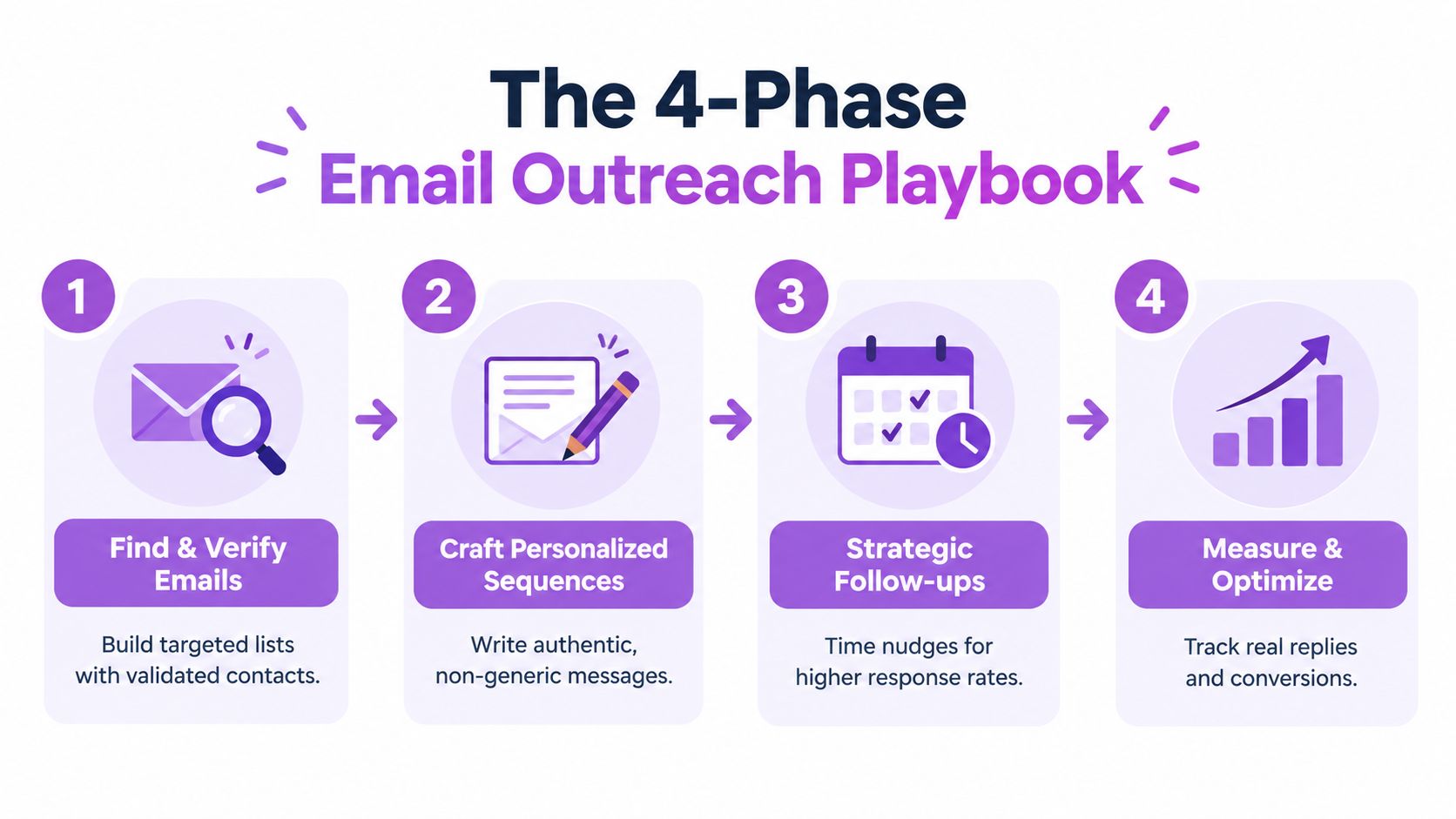
1. Find and verify emails
Start with people who fit your ideal customer profile. Then verify the address before you send anything. Hard bounces are more than an inconvenience; they're a signal that your data is weak and your sender reputation is taking unnecessary hits.
Flowkon's Email Finder & Verification is built for that first step, pulling business emails from LinkedIn prospects and verifying them before sending. That matters because an email you can't deliver can't be opened, replied to, or qualified.
2. Personalize the message
Use lead data that makes the email feel specific, first name, company, job title, and industry. The point isn't to stuff a template with merge fields. The point is to show the recipient that the message was written for someone in their seat. If you need a starting point, try the Flowkon cold email generator, then edit the draft to reflect the recipient's role and a specific reason for reaching out.
Here's a simple example:
Subject: Quick question about pipeline follow-up
Hi Maya,
I noticed your team is hiring for two SDR roles at Northbridge. If outbound volume is rising, I'd be happy to share a simple sequence framework that helps teams keep follow-up consistent without adding manual work.
Worth a look?
Best,
Sam
Before sending a generated draft, check that:
The details are accurate: Confirm the recipient's name, company, role, and any claim about their team.
The reason for reaching out is specific: Replace generic praise with a relevant, verifiable observation.
The message sounds like you: Cut filler, jargon, and wording you wouldn't use in a real conversation.
The ask is clear: Give the recipient one simple question or next step.
The email is ready to send: Check the subject line, links, signature, and opt-out process.
3. Sequence with follow-ups
Don't send one email and call it a campaign. Build a multi-step sequence with natural delays, daily sending limits, and conditions based on behavior. If a prospect replies, opts out, or converts, the sequence should stop or change immediately.
A simple cadence looks like this:
Day 1: Initial email with one clear ask
Day 3: Share one relevant proof point or new angle
Day 7: Close the loop with an easy out
Before sending each follow-up, check that:
It has a reason to exist: Add a useful detail, answer a likely question, or offer a different angle instead of repeating the first email.
The context is right: Check the recipient's name, role, previous messages, and any recent reply before sending.
The timing feels reasonable: Leave enough space between touches and avoid piling on messages across channels.
The ask is easy to answer: Stick to one clear next step and keep the message short.
The sequence should still be running: Stop or adjust it if the prospect replied, opted out, or converted.
4. Track and optimize
Track the full funnel: delivered, replied, qualified, booked. Flowkon's Email Campaign feature supports multi-step sequences, delays, conditions, and delivery tracking, so you can manage the whole loop without stitching data across tools. The useful signal is not "did we send," it's "did a qualified human answer."
Using Flowkon's AI Email Generator with a Clear Goal
The Flowkon cold email generator can be a starting point when you know what you want the email to accomplish but need help drafting it. Start by defining one goal, such as getting a reply about a specific challenge or offering a relevant resource. Then give the draft the context it needs: who the recipient is, why you're reaching out now, what you can credibly offer, and the one question you want them to answer.
For example, your brief might be: "Write a short first email to an SDR manager at a growing B2B team. The goal is to ask whether keeping follow-ups consistent is a priority. Mention their open SDR roles only if I've verified them. End with one easy-to-answer question." Review the result against the draft checklist above, then write each follow-up to add a new reason to reply rather than repeat the opener.
A generated draft is not a substitute for accurate research, a verified address, sensible sending limits, or an opt-out process. If you want to turn approved messages into a campaign, Flowkon can create, schedule, and track email campaigns; its multichannel campaigns can also coordinate email touchpoints with LinkedIn follow-ups.
Metrics That Actually Prove Outreach Success
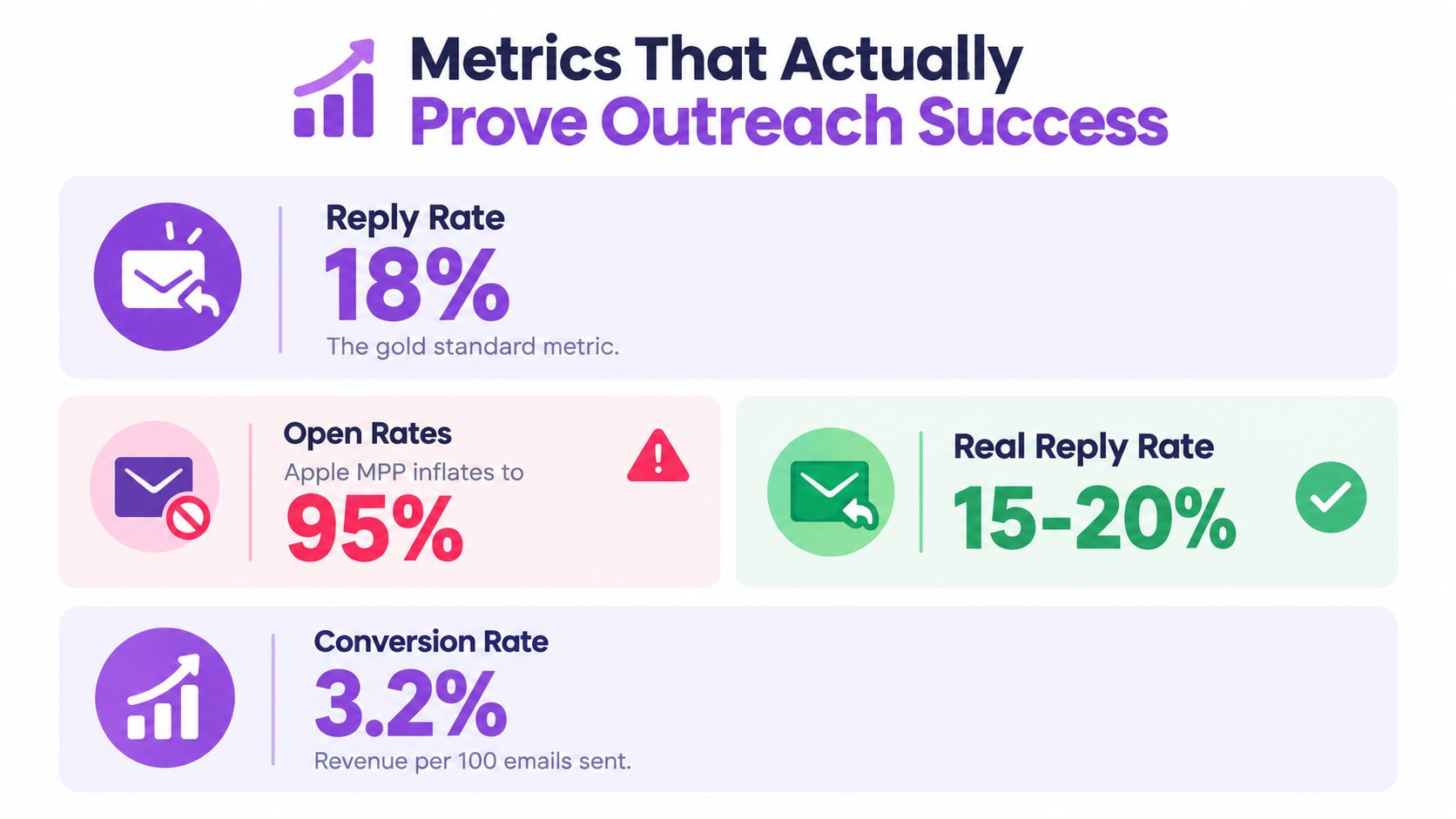
Open rates are useful only as a rough diagnostic. They're increasingly unreliable because privacy tools can make an email look opened even when no person read it. That's why open rate shouldn't be your main scoreboard for cold B2B.
What to watch instead
The more useful sequence is technical health first, then human response, then pipeline.
Inbox placement and delivery: If the message doesn't arrive cleanly, the rest doesn't matter.
Reply rate: This is a much better signal of message-market fit than opens.
Positive reply rate: Separate interested replies from “not now” and objections.
Meetings booked: This is when outreach becomes revenue work, not mailbox activity.
A recent benchmark guide recommends prioritizing inbox placement, reply rate, positive-reply rate, and meetings booked per thousand sends, and treats 5% or more cold-outbound reply performance as strong benchmark guidance. That's a better lens than staring at opens and guessing.
Useful distinction: deliverability failure means the email never landed where it should have. Message failure means it landed, but the offer, timing, or targeting didn't earn a response.
If you want to measure this properly in Flowkon, the dashboard and analytics view is the right place to start: campaign reporting and analytics.
Combining Email with LinkedIn in Multichannel Campaigns
A prospect often ignores the first email, notices a LinkedIn profile view, accepts the connection request, then replies after a later touch. That is the genuine value of multichannel outreach. The channels work better when they are coordinated around one sequence, one contact record, and one follow-up plan.
Why one flow beats two separate ones
Separate LinkedIn and email motions create duplicate touches and muddy attribution. One rep comments on a prospect's post while another sends a cold sequence, and the buyer sees disconnected attempts instead of one conversation.
Use a single sequence instead. View the profile, send the connection request, then follow with a personalized email if there is no response. Each step should support the next one, not compete with it.
Flowkon's multichannel campaign builder is built for that kind of workflow, and it gives reps one inbox for LinkedIn DMs, InMails, and email replies. That matters because they can see who replied, who ignored the message, and which follow-up should go out next without jumping between tabs. See how to combine LinkedIn and email outreach in one sequence.
Teams that centralize outreach usually move faster because the full conversation is visible in one place. They also waste less time on duplicate touches, which helps replies stay tied to one clear thread instead of scattered across channels.
Common Mistakes That Destroy Deliverability and Replies
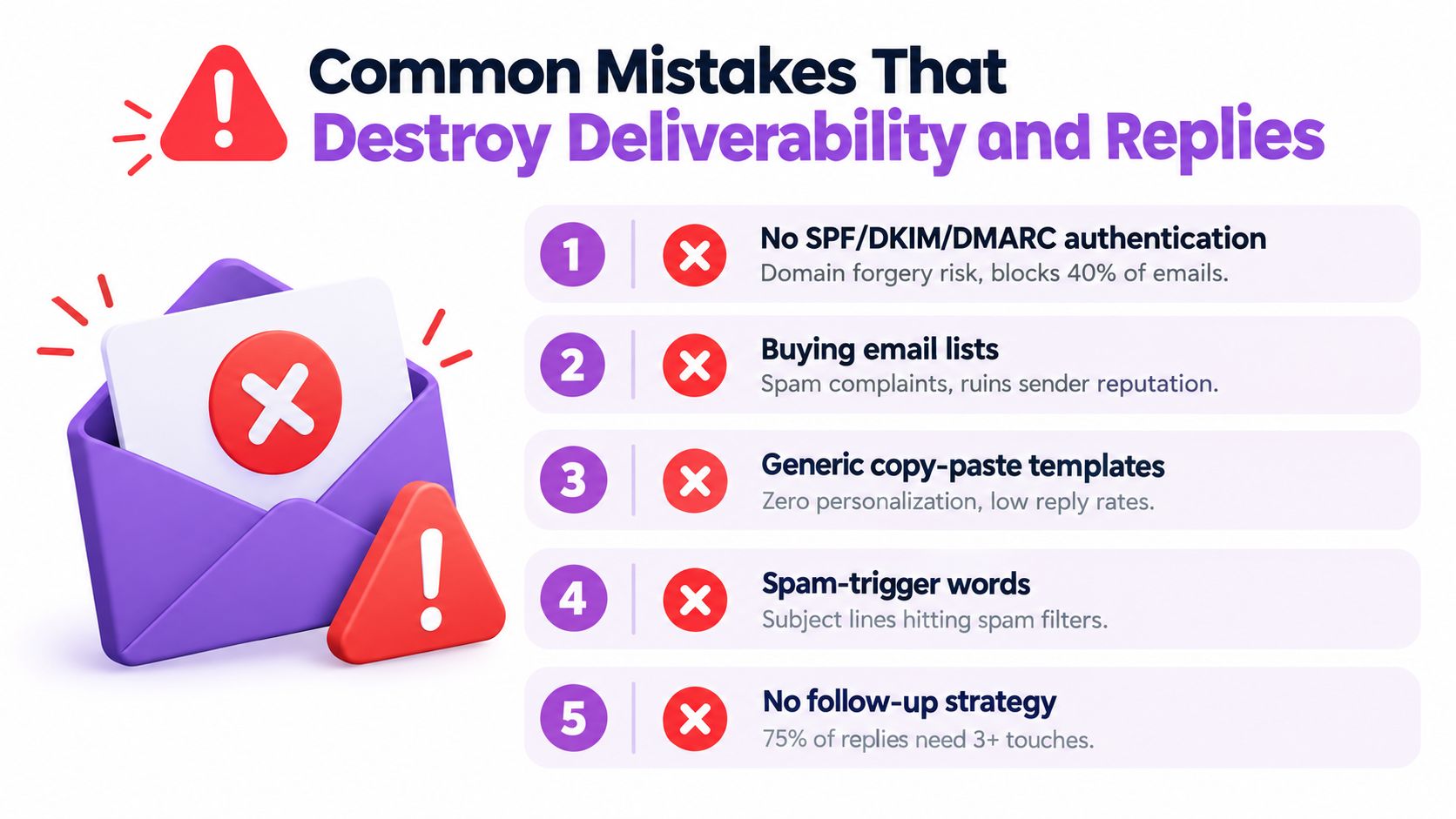
Most bad outreach doesn't fail because the copy is weak. It fails because the sender ignored the basics. If your domain isn't authenticated, your list isn't verified, or your opt-outs aren't centralized, the campaign is already in trouble.
The mistakes I'd fix first
Skipping verification: Dirty lists create hard bounces and weaken sender trust.
Sending without authentication: Google requires SPF or DKIM, and bulk senders need SPF, DKIM, and DMARC authentication guidance.
Ignoring suppression: Once a recipient opts out, every mailbox and every campaign has to honor it.
Over-sending too fast: High volume without pacing increases complaints and hurts inbox placement.
Treating follow-up as optional: Many prospects need more than one touch before they answer.
For teams that need a safer sending setup, it's smart to review warm-up and pacing options before scaling. This overview of email warm-up tool options for safer sending is a practical place to compare approaches.
If your reply rate drops and complaints rise, stop optimizing subject lines first. Check authentication, list quality, and suppression logic.
A compliant outreach program isn't just about good wording. It's a system that keeps the right people in and the wrong people out.
If you want to run email outreach with cleaner data, safer sequencing, and one place to manage replies, Flowkon gives you the campaign builder, email verification, and multichannel workflow to do it. Start a 7-day free trial, no credit card required, and build your first sequence with the guardrails already in place.