.webp)

Manually sending LinkedIn connection requests then following up to them is very tiring work. You start with writing engaging messages, but after a few hours, everything begins to feel redundant. The quality drops. Replies slow down. And eventually, you stop.
This is where linkedin automation tools used to deliver automation with precision. It's not risky by default. What makes it risky is how people use it on LinkedIn.
In this article, we will guide you through “how to automate linkedin messages in 2026, what mistakes people are still making.”
Why Manual LinkedIn Outreach does not work
Most people start with high motivation. You open LinkedIn, search for your ideal audience, and begin sending personalized messages.
Day one feels productive. Day three feels heavy. By day seven, you are either skipping outreach or rushing through it.
The problem is not effort. The problem is sustainability.
This is exactly where linkedin outreach automation becomes useful. It does not replace your thinking. It simply removes the repetitive layer so you can stay consistent without burning out.
What LinkedIn Automation Really Means Today
There is a misconception that automation means blasting hundreds of messages to strangers. That approach stopped working years ago.
Today, linkedin automation is more about structured workflows than mass messaging.
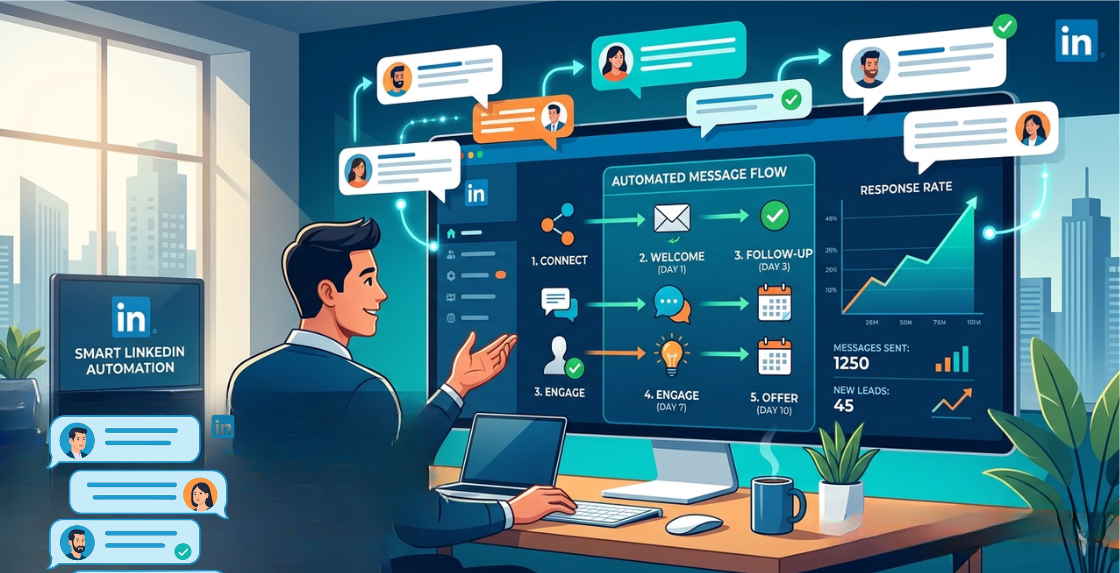
You define a sequence. For example, first a connection request, then a follow up after a few days, then maybe a value driven message. The tool simply executes this flow in a controlled way.
Good linkedin automation tools focus on pacing, personalization, and behavior based triggers. They try to mimic how a real person would interact.
That shift is important. Because LinkedIn’s algorithm is now very good at spotting unnatural activity.
Messages You Can Automate Without Sounding Robotic
Not everything should be automated, and that is where many people go wrong.
Connection requests are the easiest place to start. A short, relevant message explaining why you want to connect works well.
Follow ups are even more important. Most replies do not come from the first message. They come after a gentle reminder. Automating this step ensures you do not forget.
You can also automate simple engagement actions like profile visits or content sharing. These small touches make your outreach feel warmer.
What you should avoid automating completely are deep conversations. Once someone replies, that is your moment to step in manually.
Think of automation as the opening act, not the entire performance.
Is LinkedIn Automation Safe
Short answer, yes. But only when done right.
LinkedIn is strict about spam, not automation itself. If your activity looks aggressive or unnatural, you will face restrictions.
Most issues happen when people push limits too fast. Sending too many requests, using generic messages, or running outdated tools.
Safe linkedin outreach automation is about staying within human-like behavior. That means controlled volume, gradual scaling, and relevant messaging.
Tools like Flowkon are designed around this idea. Instead of pushing volume, they focus on maintaining a natural rhythm that keeps your account safe while still delivering results.
Top Benefits Except Saving Time
Most common benefit of automation is, It saves time, except this:
Another important advantage is consistency. Your outreach continues even on days when you are busy or not in the mood to send messages.
It also improves your pipeline. When you are reaching out regularly, you naturally create more opportunities.
It also helps in precision. Instead of spending hours on repetitive tasks, you spend your time on actual conversations that move deals forward.
If you are using a proper linkedin lead generation tool, you also get better visibility into what is working. You can see which messages get replies, which audiences respond, and where you need to adjust.
Choosing the Right LinkedIn Automation Tools
Not all tools are built with the same features, and this is where many people make mistakes. There are browser based tools, desktop applications, and cloud platforms. Each comes with its own trade offs.
Browser tools are easy to start with but often risky because they rely on your active session. Desktop tools give more control but require setup and maintenance.
Cloud based linkedin automation tools are generally the safest option today. They operate in controlled environments and follow structured activity patterns.
More importantly, they are designed to scale without putting your account under stress.
A platform like Flowkon fits well here because it focuses on balancing automation with safety rather than pushing aggressive outreach.
What Actually Makes Cloud Tools Safer
It is not just about where the tool runs. It is about how it behaves.
Good cloud tools manage activity pacing. They introduce delays between actions so your behavior does not look robotic.
They also control daily limits automatically. This prevents you from overdoing outreach without realizing it.
Another important factor is stability. Since these tools run independently of your device, your campaigns continue without interruptions.
When you combine these elements, you get linkedin automation that feels natural rather than forced.
Practical Use Cases That Work
If your account is new or inactive, begin with a low number of daily actions. Even 10 to 15 is enough in the beginning.
Increase gradually: Do not jump from 10 messages to 50 overnight. Let your account build activity history.
Write like a human: Avoid overly polished or sales heavy language. Simple and clear messages work better.
Mix your actions: Do not just send messages. View profiles, like posts, and engage occasionally. This creates a balanced activity pattern.
Review your results: If people are not replying, it is not always the tool. Sometimes it is a problem with the message or the targeted audience.
And most importantly, stay patient. LinkedIn lead generation is a long game, not a quick win.
Common Mistakes That Hamper Results
One of the biggest mistakes is treating automation like scoring more leads in a short time. Sending more messages doesn’t mean getting more leads. Better messages deliver more results rather than a higher number of sent messages.
Another mistake is ignoring context. Sending the same message to everyone rarely works. People can tell when there is no real intent behind a message.
Over-follow up is also a problem. If someone does not respond after multiple attempts, it is better to move on.
Some users also rely entirely on automation without improving their profile. But your profile is what people check before replying. If it does not build trust, your outreach will struggle.
And finally, using poor quality sales automation software can do more harm than delivering good results. The tool you choose plays a major role in both safety and performance.
Final Words
There is no shortcut to building relationships on LinkedIn. Automation does not change that.
What it does is eliminates complexity. It helps you stay consistent, organized, and present without spending hours on repetitive work.
The real advantage comes when you combine smart linkedin automation with genuine communication. That is where results start to compound.
If you approach it with the right mindset and use reliable linkedin automation tools like Flowkon, you can build a system that generates leads steadily without risking your account.
In the end, people do not respond to automation. They respond to relevance. Automation just helps you reach them at the right time.



.png)



.svg)

