

If you want the best time to post on LinkedIn for B2B sales, start with Tuesday through Thursday, between 10:00 a.m. and 2:00 p.m. in your audience's local time zone. If you want the strongest single default, test Tuesday at 11:00 a.m. local time first.
That recommendation reflects the clearest overlap across major ranking articles and published timing guides, including Lemlist's guide to the best time to post on LinkedIn and Kanbox's breakdown of the best times to post on LinkedIn. Both point to weekday posting, especially late morning through early afternoon, with local time as the key filter.
For B2B sales teams, timing matters because the goal is not just more likes. The goal is to put your post in front of buyers, champions, and decision-makers early enough to drive profile visits, connection acceptance, replies, and meetings booked.
Quick answer, the best time to post on LinkedIn
For B2B sales, the best time to post on LinkedIn is usually Tuesday through Thursday, from 10:00 a.m. to 2:00 p.m. in your audience's local time zone. If you want one default slot to test first, start with Tuesday at 11:00 a.m. local time.
This window works best because it reaches buyers during the workday, when they are more likely to see your post, visit your profile, accept a connection request, and reply.
The Quick Answer and Why Timing Matters for Pipeline
What the 3 biggest studies say
Most published LinkedIn timing studies point in the same general direction, weekday posting during working hours, especially mid-morning through early afternoon. The differences usually come from audience mix, geography, and how each dataset defines success.
This article keeps the practical overlap front and center while also noting the broader benchmark references already shaping search results, including Lemlist's guide to the best time to post on LinkedIn and Kanbox's breakdown of the best times to post on LinkedIn.
Best Time to Post on LinkedIn for B2B Sales, Quick Answer First
How to read published times correctly
Common Mistakes and Final Recommendations
Use content and outreach together
Integrating Content Timing with Multichannel Outreach
Your 14-Day Posting Time Testing Plan
Global B2B Time Zone Conversion Reference
Navigating Time Zones and Global Audiences
Format matters, but not the way people think
Industry and account type change the pattern
Adjusting for Industry, Format, and Account Type
Major LinkedIn Timing Studies Compared
What the Major Data Sources Actually Say
Major LinkedIn timing studies compared
The clean takeaway is that Tuesday through Thursday remains the safest starting block, especially if your audience is made up of working professionals in B2B categories.
Why the studies disagree, and which one to trust
The studies disagree because they do not measure the same thing. Some look at engagement across broad social datasets. Others focus on professional audiences, specific account types, or a narrower set of time slots.
A second issue is geography. A posting time that looks strong in one study may reflect North American behavior, while another includes European or APAC audiences. A third issue is account mix. Personal profiles, executive creator accounts, and company pages do not perform the same way.
So which study should you trust? Use the broad overlap first, then trust your own account data most.
Best practical rule: use published timing studies to choose your first tests, then let your own LinkedIn analytics decide the winner.
For B2B sales teams, the most trustworthy signal is not just engagement. It is whether posts published in a given window increase qualified profile visits, connection acceptance, replies, and meetings booked.
Best time to post on LinkedIn by day of the week
The best time varies a bit by day, but the strongest pattern still centers on the workday. Here is the most useful day-by-day starting guide.
Monday
Monday can work, but it is often less reliable than Tuesday through Thursday. Professionals are catching up on meetings, email, and planning, so reach may be slower to build.
Best starting window for Monday: 10:00 a.m. to 12:00 p.m. local time.
Tuesday
Tuesday is usually the strongest day to post on LinkedIn. Many benchmarks and ranking articles point to it as the best mix of attention, workday focus, and responsiveness.
Best starting window for Tuesday: 10:00 a.m. to 2:00 p.m. local time, with 11:00 a.m. as the strongest first slot to test.
Wednesday
Wednesday is often just as strong as Tuesday, especially for thought leadership, educational content, and posts tied to active prospecting.
Best starting window for Wednesday: 10:00 a.m. to 2:00 p.m. local time, with 1:00 p.m. worth testing if you want a midday option.
Thursday
Thursday usually remains strong, though some audiences start tapering later in the afternoon.
Best starting window for Thursday: 10:00 a.m. to 2:00 p.m. local time.
Friday
Friday can still perform, but results are often less consistent for B2B sales content. Attention may drop as the workweek winds down, especially late in the day.
Best starting window for Friday: 10:00 a.m. to 12:00 p.m. local time.
Saturday and Sunday
Weekend posting is usually weaker for standard B2B sales content, but not always useless. Some founder-led profiles and creator-style accounts see occasional weekend engagement.
Best starting window for weekends: test only if your audience is known to be active, usually late morning.
Best day to post on LinkedIn, ranked list
If you want a simple ranked order to start with, use this:
- Tuesday
- Wednesday
- Thursday
- Friday
- Monday
- Saturday
- Sunday
That ranking is a practical synthesis of the patterns most often repeated in published guides and benchmark summaries.
Best time to post on LinkedIn by industry
Industry changes the pattern because different professionals use LinkedIn differently. Use the ranges below as starting points, not fixed rules.
For software and tech audiences, many recommendations align closely with Lemlist's guide to the best time to post on LinkedIn, especially around weekday late morning and midday windows.
Best time to post on LinkedIn in India (IST) and other time zones
If your audience is in India, use 10:00 a.m. to 2:00 p.m. IST as the default starting range. That follows the same local-workday logic used in global studies, but it should still be tested against your own audience behavior.
The same applies to any region. A published recommendation only becomes useful when converted into the target buyer's local workday.
How to post for a global audience
If your audience spans regions, the wrong time zone can make a good post look weak. The best rule is simple, publish for the audience's local workday, not your own office time.
If one region drives most pipeline, optimize for that region first. If you sell across North America, Europe, and APAC, consider separate publishing cadences instead of one compromise slot.
For B2B sales teams, this also affects follow-up timing. Your content window and your outreach window should work together, not compete. Flowkon for sales teams fits naturally into that workflow when teams want to align posting, connection requests, and follow-ups more deliberately.
Time zone conversion table
That table uses standard offsets, so daylight-saving changes may shift converted times. Scheduling for the audience's local clock is the safest option.
Best time to post by content format
Format matters, but not in the way many people think. A great carousel or video posted at the wrong time may still underperform, while weak content will not be rescued by perfect timing.
Keep format constant while testing timing, otherwise you cannot tell what actually changed the result.
Worst times to post on LinkedIn
The worst times are usually the ones that miss your audience's working rhythm. For many B2B audiences, that means:
- Very late at night
- Very early morning before the workday starts
- Late Friday afternoon
- Random global posting that ignores the buyer's local time
These are not universal bans, but they are weak default choices for most B2B sales teams.
Why timing matters, the first 60 to 90 minutes and the LinkedIn algorithm
LinkedIn distribution is heavily influenced by what happens soon after a post goes live. If the right people see it early and react, comment, click, or visit your profile, the post has a better chance of earning wider reach.
That is why timing matters. A post does not just need to exist, it needs to appear when your audience is available to notice it. For sales teams, the first 60 to 90 minutes can shape whether a post becomes a useful warm-up signal for later follow-up.
Personal profile vs company page, does the best time differ?
Yes, often it does. Personal profiles usually have more room for opinion-led, story-led, or creator-style posts that can sometimes perform outside strict office hours. Company pages tend to depend more on workday alignment and consistent posting habits.
If you run both, do not assume one time slot should automatically be shared across both account types.
How to find your own best time to post
Published studies are useful, but your own account data matters more. The goal is to identify the time windows that produce the outcomes you actually care about.
Using LinkedIn Analytics
Review metrics such as impressions, engagement rate, clicks, comments, reposts, and follower demographics. Then connect those to the signals that matter more for B2B sales, such as profile visits, connection acceptance, direct replies, and meetings booked.
RedactAI's LinkedIn timing tips makes the same practical point, benchmarks are useful starting points, but audience behavior should guide the final decision.
A 14-day testing plan
A two-week test is long enough to gather directional data and short enough that most teams will actually complete it.
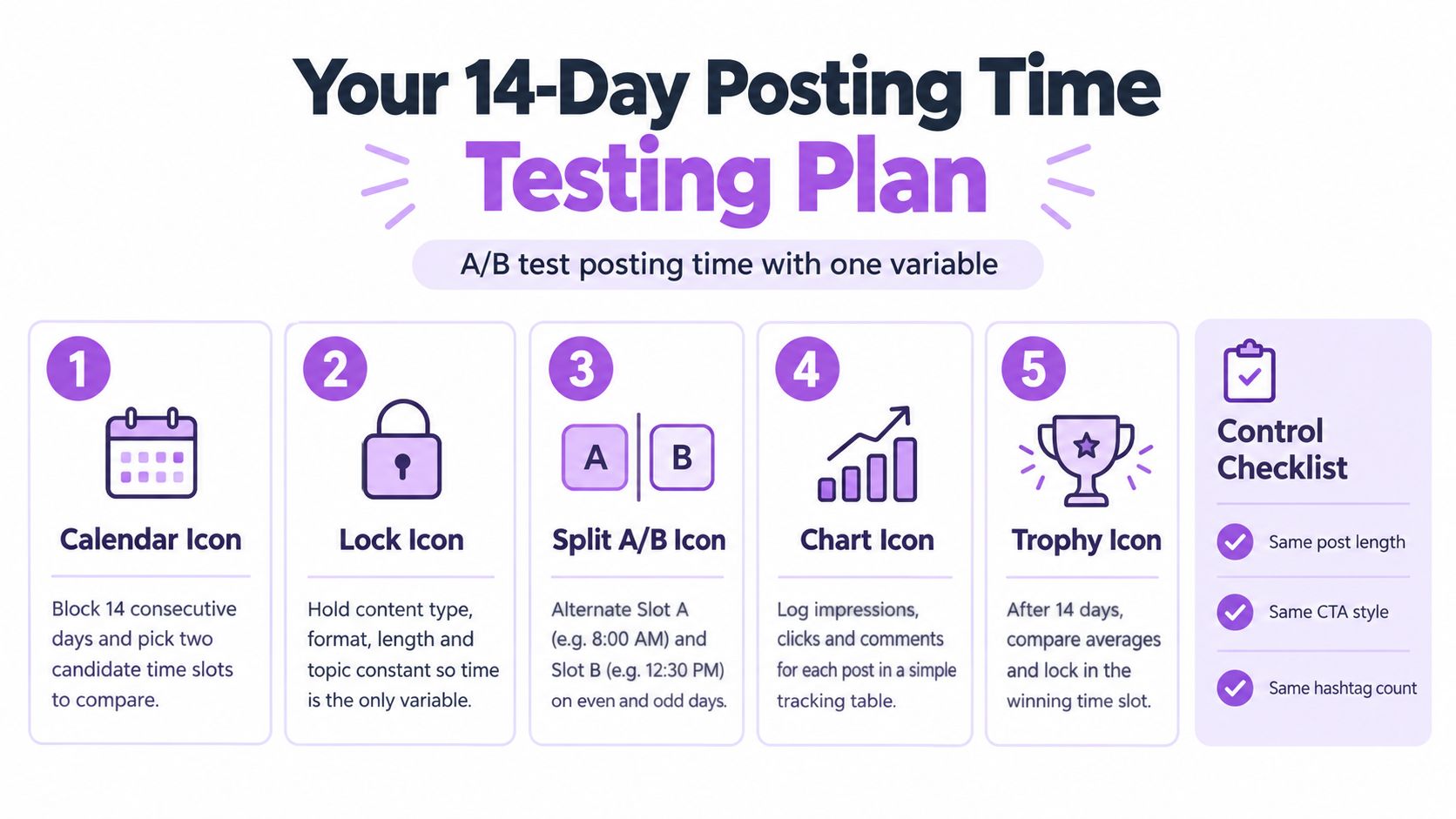
Use two or three time slots drawn from the benchmark windows above, such as:
- Tuesday at 11:00 a.m.
- Wednesday at 1:00 p.m.
- Thursday at 10:00 a.m.
Keep the topic, format, post length, and call to action as similar as possible. Then review results at both 24 hours and 72 hours.
A practical checklist helps:
- Hold the message constant
- Keep the format stable
- Use the same audience segment
- Log the result at 24 and 72 hours
- Compare business signals, not just reactions
If you want a place to connect content timing with outreach results, Flowkon's dashboard and analytics can sit alongside LinkedIn analytics by tracking acceptance, reply, and click-through performance in the outreach layer.
Using scheduling tools
Scheduling tools help you publish consistently, but they do not improve reach on their own. Their value is operational, they help you hit the intended test window reliably.
That matters when you are trying to turn posting into a repeatable system instead of a guess.
How often should you post on LinkedIn?
For most B2B teams, consistency matters more than volume. A realistic starting cadence is two to four posts per week, published in tested windows that match the audience's workday.
If you post more often, make sure quality stays high. More posts do not automatically mean better results.
Common mistakes when choosing a posting time
How to do multichannel outreach
The most common mistakes are simple but costly:
- Ignoring local time zones
- Optimizing for likes instead of pipeline signals
- Changing topic, format, and timing at the same time
- Assuming one study is universally correct
- Making decisions from one strong post
- Using the same timing for company pages and personal profiles without testing
The right process is to start with strong benchmark windows, then narrow your schedule using your own analytics.
Conclusion
The practical answer is simple. Start with Tuesday through Thursday, prioritize 10:00 a.m. to 2:00 p.m. in your audience's local time, and test your own audience behavior against real business outcomes.
For B2B sales teams, the goal is not just engagement. It is whether your posts help create more profile visits, connection acceptance, replies, and meetings.
If you want to turn posting time into a repeatable system instead of a guess, use Flowkon to connect timing, outreach, and campaign reporting in one workflow. Start with your own LinkedIn analytics, test two or three posting windows, and use the results to shape both your content schedule and your multichannel outreach.