.webp)

Introduction
There is a moment most sales teams quietly notice but rarely talk about. You send a batch of emails, check replies, and nothing meaningful comes back. Then you try linkedin automation, hoping a different channel will fix the problem. A few replies come in, but not enough to justify the time spent.
It does not feel like failure. It feels like something is missing.
That missing piece is not a better copy or sharper targeting. It is visibility. Modern buyers do not respond to one message on one platform. They respond after seeing you more than once, in different places, at different times. That is where multichannel outreach changes the game.
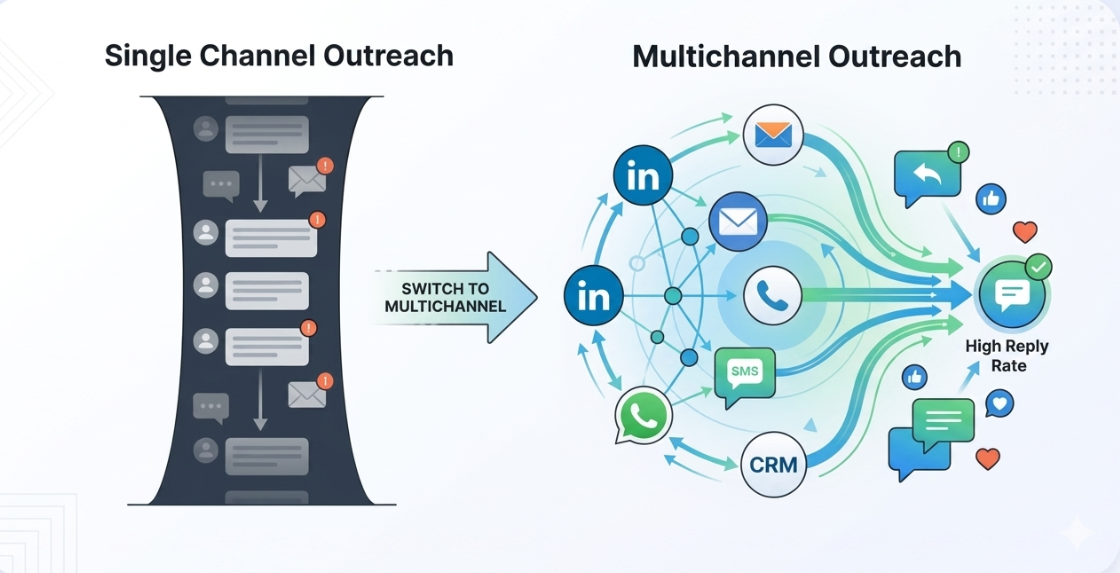
Why Single Channel Outreach Is Losing Impact
Running a campaign on just one channel used to work. Email alone could generate conversations. LinkedIn alone could open doors. That is no longer the case.
Buyers today are overloaded. Their inbox is crowded. Their LinkedIn feed is full of similar messages. Even a well written outreach can get ignored simply because it arrived at the wrong moment.
Some key realities explain this shift:
- Most professionals do not respond to the first message
- A large share of replies comes from follow ups
- Buyers often need multiple interactions before they engage
When you rely on a single channel, you depend too much on timing. If your message is missed once, you lose the opportunity entirely.
With linkedin outreach automation alone, you get only one surface to reach your prospect. The same applies to email. There is no reinforcement, no reminder, no second chance.
Understanding the Multichannel Advantage
Multichannel outreach is not about sending more messages. It is about creating a connected experience across platforms.
When a prospect sees your email and then your LinkedIn profile, something changes. You are no longer just another sender. You become a real person with context.
This shift builds familiarity and trust without increasing pressure.
A well planned multichannel outreach sequence allows you to
- Reach prospects where they are most active
- Space communication naturally across platforms
- Reinforce your presence without repeating yourself
- Increase the chances of being seen at the right time
Instead of pushing harder on one channel, you spread your effort intelligently.
Real Performance Comparison
To understand why this works, it helps to look at typical outcomes across channels:
The improvement is not small. It is often the difference between an empty pipeline and a consistent flow of conversations.
The reason is simple. Each channel supports the other.
- Email gives scale
- LinkedIn adds credibility
- Together they create recognition
A Practical LinkedIn and Email Outreach Sequence
A successful b2b outreach sequence does not need to be complicated. It needs to be structured and timed correctly.
Here is a simple five step approach that works well:
Step 1: Start with Email
Send a short, clear email.
- Keep it concise
- Focus on one idea
- Avoid heavy pitching
The goal is to introduce yourself, not close a deal.
Step 2: Connect on LinkedIn
After a couple of days, send a connection request.
- No long message needed
- Keep it natural and simple
At this point, your name already feels familiar.
Step 3: Send a LinkedIn Message
Once connected, follow up with a brief message.
- Reference your earlier email
- Keep the tone conversational
- Avoid repeating the same script
This is often where conversations begin.
Step 4: Follow Up via Email
If there is no reply, send another email.
- Add a new angle
- Share a quick insight or example
- Keep it relevant
Do not resend the same message.
Step 5: Close the Loop
Send a final message.
- Be honest and direct
- Give the prospect an easy way to respond
This step often gets surprising results because it feels genuine.
Common Mistakes to Avoid
Not every automated outreach campaign performs well. In many cases, the issue is execution.
Here are three common mistakes:
1. Overloading the Prospect
Sending messages on multiple channels on the same day creates friction.
Instead:
- Space your communication
- Let each touch feel intentional
2. Copying the Same Message Everywhere
Your LinkedIn message should not look like your email.
- LinkedIn should feel conversational
- Email can carry more detail
3. Ignoring Behaviour Signals
Not all prospects behave the same way.
- Some open emails multiple times
- Some engage on LinkedIn
Your sequence should adapt based on these signals.
Managing Multichannel Without Chaos
One reason teams avoid multichannel campaign strategies is complexity.
Managing two platforms manually can become overwhelming:
- Switching between tools
- Tracking responses
- Updating CRM records
- Following up at the right time
This is where tools like Flowkon simplify execution.
Instead of handling each step manually, you can:
- Build a complete multichannel outreach sequence in one place
- Automate LinkedIn and email actions together
- Track every interaction in real time
Track every interaction in real time
What Changes When You Shift Strategy
Moving from a single channel to linkedin and email outreach creates noticeable improvements.
Better Reply Rates
You create multiple opportunities for engagement instead of relying on one message.
Faster Conversations
Prospects respond sooner because they see you more than once.
Clearer Pipeline Visibility
Every interaction is tracked, making it easier to understand what is working.
Less Manual Work
Automation reduces repetitive tasks and keeps campaigns organised.
Final Words
Single channel outreach is not failing because the channels are weak. It is failing because it does not reflect how people respond today.
Buyers need context. They need repetition. They need to recognise you before they engage.
A well structured multichannel outreach approach gives you that advantage. It allows you to show up more than once, without becoming intrusive.
When done right, it feels natural. It feels human. And most importantly, it works.
The shift is not about doing more. It is about doing it smarter.


.png)


.svg)

